
India-US trade deal: Piyush Goyal announces zero tariff on key exports to US, check here
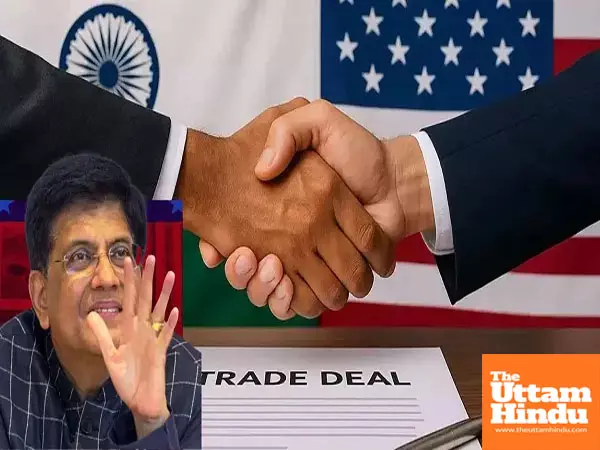
New Delhi (The Uttam Hindu) : A significant development has been made toward elevating trade relations between India and the United States. The two countries have agreed on an interim trade framework to achieve the bilateral trade target of $500 billion. This agreement is being seen as expanding opportunities for Indian exporters in the US market.
Union Commerce and Industry Minister Piyush Goyal on Saturday described the interim trade agreement as a historic initiative for India's economic future. He said the agreement will lay a strong foundation towards the goal of a "Developed India 2047."
Piyush Goyal said that through this agreement , Indian exporters will get access to the US market, one of the world's largest economies, with 'Most Preferred Duty'. He said that the India-US joint statement has received a positive response globally. Goyal said, "This day will be recorded in golden letters in India's business history. There is an atmosphere of enthusiasm and hope across the country. This agreement will prove to be a decisive milestone in the journey of developed India."
Under this agreement, India gains improved access to the US market for its key export sectors—pharmaceuticals (generic drugs), gems and jewelry, and aircraft parts. The US has committed to eliminating tariffs on a wide range of these Indian products after the interim agreement is completed. In the aviation sector, the US will remove tariffs on aircraft and their parts that were previously subject to national security measures related to the import of aluminum, steel, and copper. For the auto sector, India will benefit from a preferential tariff rate quota. This means that Indian auto parts manufacturers will receive tariff concessions compared to other non-priority suppliers in the US market, giving them a competitive advantage.
Trade negotiations were ongoing since February 2025
Trade negotiations between India and the US began in February 2025 with the aim of achieving an annual trade level of $500 billion. The Minister said that this interim agreement has set the stage for turning that goal into reality. He praised the leadership of Prime Minister Narendra Modi and US President Donald Trump, saying that the visionary thinking of both leaders has given new strength to bilateral relations.
Goyal stated that this agreement will bring new opportunities, particularly for Indian exporters, small and medium enterprises (MSMEs), farmers, and fishermen. This will not only boost job creation but also open up avenues for investment and innovation .
Duty-free access for gems, pharmaceuticals, and several agricultural products
Under the new trade framework, several key Indian products will be allowed to be exported to the US without any duty. These include gems and jewellery, pharmaceuticals, pharmaceuticals, coffee, and mangoes. In addition, tea, spices, coconut oil, arecanut, vegetable wax, chestnuts, Brazil nuts, fruits and vegetables, barley, cereals, bakery products, cocoa products, sesame, poppy seeds, and citrus juices will also receive duty-free access.
From 50% tariff to zero duty
Piyush Goyal said that many products that previously faced up to 50% duty in the US can now be exported at zero duty. He pointed out that while China has been hit with a 35% tariff and Bangladesh and Vietnam with a 25% tariff, India has received comparatively better terms.
Farmers' interests are fully protected
The Minister clarified that this agreement does not compromise farmers' interests. Products such as aircraft and machinery parts, generic medicines, pharmaceuticals, gemstones and diamonds, coins, platinum, watches, essential oils, decorative items, seeds, and inorganic chemicals are also included in the zero-duty category.
Clear boundaries set in some areas
Goyal said that India kept its red lines clear during the agreement. Genetically modified (GM) products will not be allowed in India. No concessions have been given on staple food crops like maize, rice, wheat, millet, and ragi. Furthermore, fruits produced in the country on a large scale, such as bananas and citrus fruits, meat, poultry, dairy products, soybeans, sugar, cereals, chickpeas, ethanol, and tobacco have been completely protected.
Piyush Goyal expressed confidence that this India-US interim trade agreement neither harms the interests of farmers, nor MSMEs, nor the handloom and handicraft sectors, but rather provides them with new global opportunities.