
Historic Financial Reset for Delhi: Delhi Government under the leadership of CM Rekha Gupta Signs Transformational MoU with RBI
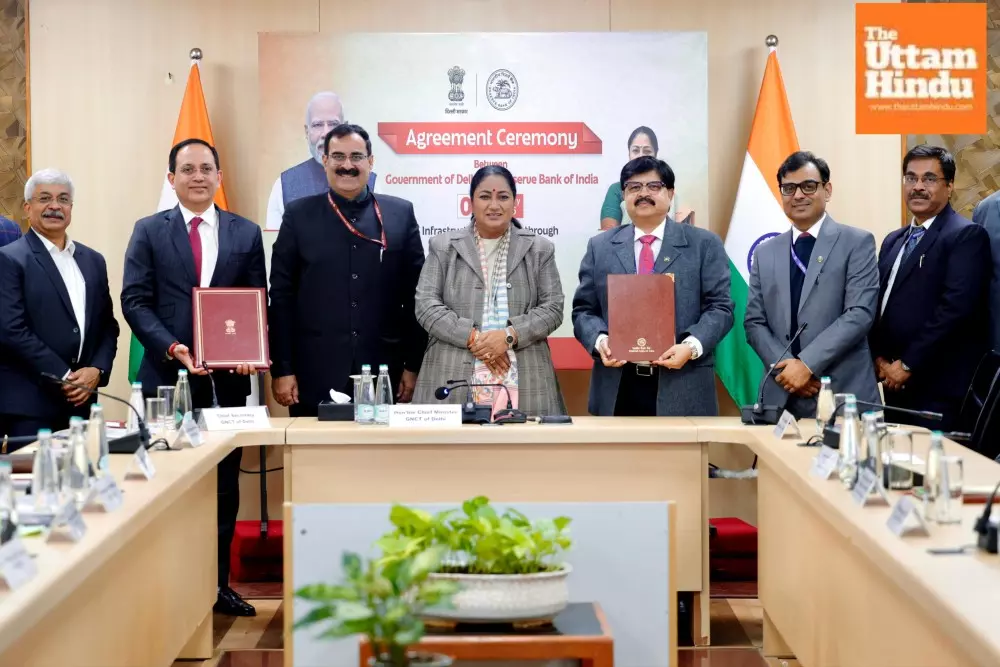
New Delhi (The Uttam Hindu): In a historic and far-reaching reform that fundamentally reshapes Delhi’s public financial management framework, the Government of NCT of Delhi today signed a landmark Memorandum of Understanding (MoU) with the Reserve Bank of India. The agreement represents a decisive break from past practices and ushers Delhi into a new era of fiscal prudence, institutional discipline, and infrastructure-led economic growth.
The MoU enables the Reserve Bank of India to function as the banker, debt manager, and financial agent of the Government of NCT of Delhi, facilitating market borrowings through State Development Loans, automatic investment of surplus cash, professional cash management, and access to low-cost liquidity facilities, strictly within the framework prescribed by the Government of India and the RBI Act. The MoU was signed at a meeting held at the Delhi Secretariat, chaired by the Chief Minister, between Reserve Bank of India and Mr. Bipul Pathak, Additional Chief Secretary (Finance) of the Delhi Government. Senior officials from the Delhi Government and the Reserve Bank of India, including Delhi Chief Secretary Mr. Rajiv Verma, were also present on the occasion.
Chief Minister Smt. Rekha Gupta, who also holds the Finance portfolio in the Delhi Government, described the MoU as a transformational milestone and a long-overdue reform that previous governments failed to initiate.
“This agreement marks a historic correction in Delhi’s financial governance. Despite being the nation’s capital, Delhi was denied the benefits of structured RBI banking and market borrowings for years. Earlier governments never showed the intent or vision to adopt globally accepted norms of fiscal prudence. Today, that decisively changes,” the Chief Minister stated.
Previous Neglect, Present Reform
The Chief Minister underlined that successive AAP governments neither invested surplus public funds nor adopted cost-efficient borrowing mechanisms. Excess cash remained idle, resulting in loss of interest income, while borrowings were undertaken at high interest rates from other sources, placing an unnecessary burden on public finances and, ultimately, on citizens.
“In contrast, this government has placed fiscal discipline, transparency, and long-term sustainability at the core of governance. Every rupee of public money must now work for the people of Delhi,” she said.
Key Fiscal Transformations under the MoU
Automatic investment of surplus funds
Any excess cash balance with the Delhi Government will now be automatically invested on a daily basis through RBI mechanisms, generating interest income and eliminating losses caused by idle funds.
Low-cost liquidity support from RBI
Delhi will have access to Ways and Means Advances and Special Drawing Facilities from RBI, ensuring efficient management of temporary cash flow mismatches without resorting to expensive or emergency borrowing.
Market borrowings at competitive rates
For the first time, Delhi will raise funds from the open market at competitive interest rates of approximately 7 percent through State Development Loans, replacing earlier high-cost borrowing at interest rates of 12 to 13 percent from alternative sources.
Full integration with RBI banking system
With this MoU, Delhi now stands at par with other States and Union Territories with legislatures, benefiting from RBI’s professional banking, cash management, and debt management systems.
The Chief Minister stated that this major reform is the outcome of sustained engagement with the Union Government and follows her recent meeting with Hon’ble Union Finance Minister Smt. Nirmala Sitharaman in December 2025, where key issues concerning fiscal autonomy and modernisation of Delhi’s financial architecture were discussed.
She expressed sincere gratitude to Hon’ble Prime Minister Shri Narendra Modi for his visionary leadership and continued guidance, and for enabling Delhi to secure an independent and transparent banking framework aligned with national fiscal norms.
Pursuant to a Government of India notification dated 2 January 2026, effective from 9 January 2026, the Public Accounts of the Government of NCT of Delhi have been separated from the Public Accounts of the Government of India, providing Delhi an independent banking and borrowing structure for the first time.
Infrastructure with Responsibility
The Chief Minister reiterated that all funds raised through market borrowings will be utilised exclusively for capital expenditure, ensuring durable asset creation without transferring short-term liabilities to future generations. Capital investment has a high multiplier effect and is critical for long-term economic growth. Reflecting this commitment, the Budget for 2025–26 provides for capital expenditure nearly 135 percent higher than the actual expenditure of the previous year.
Priority sectors to benefit from this financing include
Yamuna rejuvenation and drainage infrastructure
Drinking water supply systems
Hospitals and health infrastructure
Public transport and urban mobility
Roads, flyovers and other essential urban infrastructure
The Chief Minister emphasised that strict fiscal discipline, RBI-guided processes, and institutional investor participation will enhance Delhi’s economic competitiveness, generate employment, and significantly improve the quality of life for citizens.
“This MoU is not merely an administrative arrangement. It is a historic financial reform that Delhi will benefit from for decades. With this step, Delhi embarks on a new journey of responsible governance, strong institutions, and sustainable growth, fully aligned with the vision of a developed India,” the Chief Minister concluded.