
From Law to Lived Reality: Centre Accelerates Inclusive, Technology-Driven Empowerment for Persons with Disabilities
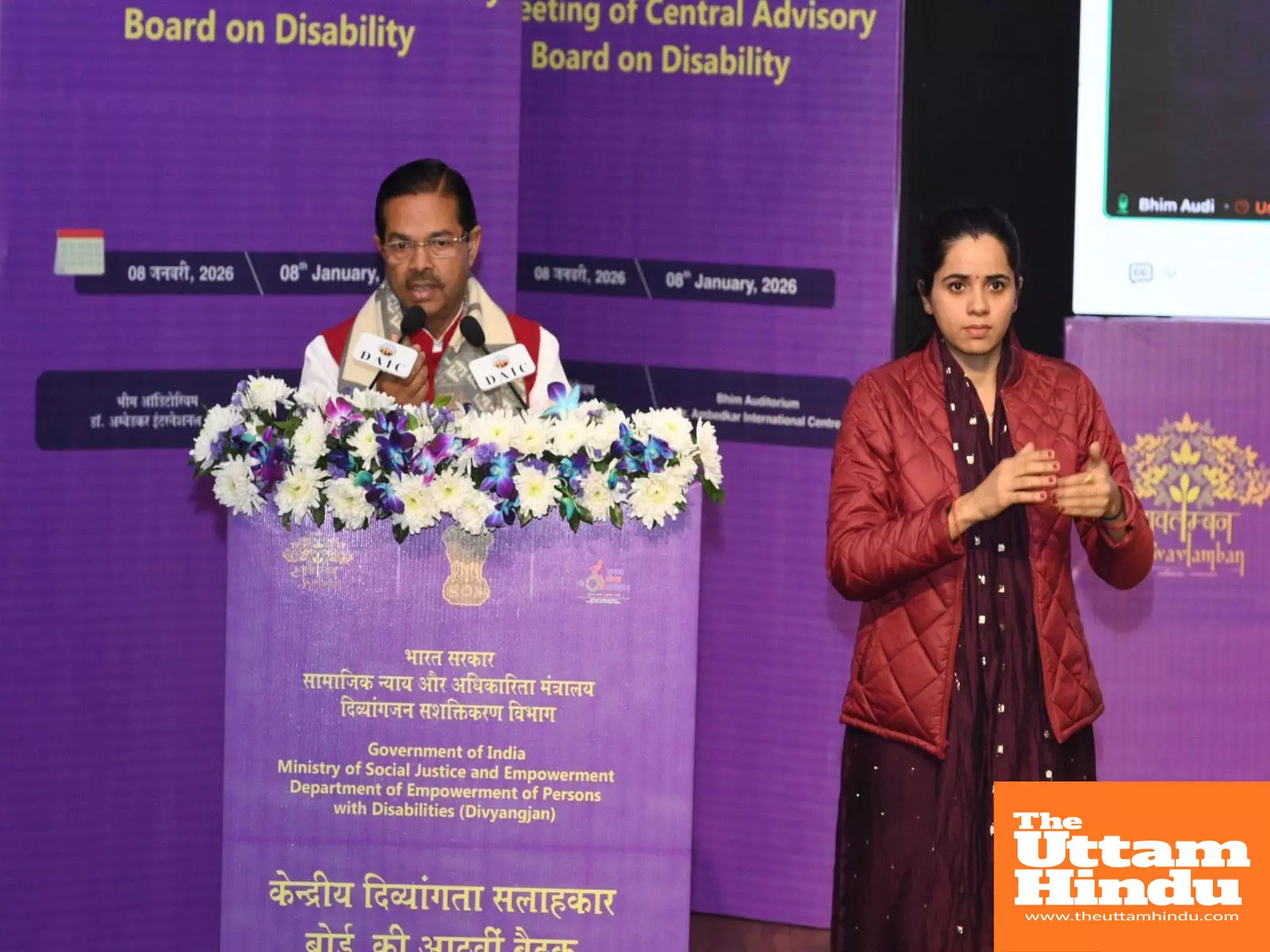
New Delhi(The Uttam Hindu): “Sabka Saath, Sabka Vikas, Sabka Vishwas must be reflected in the everyday lives of persons with disabilities, through timely services, effective institutions, and collective effort,” stated Dr. Virendra Kumar, Hon’ble Union Minister of Social Justice and Empowerment, while chairing the 8th Meeting of the Central Advisory Board (CAB) constituted under the Rights of Persons with Disabilities (RPwD) Act, 2016. The meeting took place at the Dr. Ambedkar International Centre in New Delhi. The Minister reaffirmed the Government of India’s strong commitment to accessibility, inclusion, and empowerment, emphasizing that dialogue and cooperative federalism are essential for translating progressive legislation into tangible outcomes.
During the meeting, Dr. Virendra Kumar reviewed the implementation status of the RPwD Act across States and Union Territories. He called for strengthening institutional mechanisms, enhancing trained personnel, and ensuring rigorous monitoring. He emphasized the need for timely delivery of services by urging States to expedite disability certification and the issuance of Unique Disability Identification (UDID) cards. This could be achieved by increasing the frequency of Disability Board meetings, expanding the network of notified hospitals, engaging empanelled private specialists, and improving awareness and oversight at the State level regarding the UDID Project. The Minister noted that productive discussions in forums like the CAB allow for valuable suggestions to converge, enabling better policy calibration and execution.
Key discussions highlighted by the Minister included the integration of the UIDAI-UDID API and the identification of over 45,000 persons with disabilities in Tamil Nadu, whose data can now be streamlined through State databases. He acknowledged calls for the reintroduction of incentives for private sector employers hiring persons with disabilities and requests for renewed outreach under the Accessible India Campaign. Dr. Virendra Kumar also stressed the importance of timely utilization of funds under flagship schemes such as the Assistance to Disabled Persons for Purchase/Fitting of Aids and Appliances (ADIP), cochlear implant programs, and accessibility initiatives, noting that proactive action by States significantly accelerates service delivery. Discussions also touched on the expansion of Composite Regional Centres (CRCs), particularly in Ladakh, Sikkim, and the North-Eastern region, within the framework of balanced regional development envisioned by Hon’ble Prime Minister Shri Narendra Modi.
Shri B. L. Verma, Hon’ble Minister of State for Social Justice and Empowerment, welcomed the members and emphasized the CAB’s role as a vital platform for coordinated action between the Centre, States, and stakeholders. He stressed the shift from policy intent to field-level implementation and highlighted the need for quality service delivery, strengthening the UDID ecosystem to reduce backlogs, and last-mile outreach under the ADIP Scheme, especially in remote and underserved areas. He also mentioned the necessity for close coordination under the ADIP-SSA Scheme for Children with Special Needs and timely utilization of funds under schemes such as AIC–SIPDA.
Smt. V. Vidyavathi, Secretary of the Department of Empowerment of Persons with Disabilities, reiterated that the CAB is the apex policy-recommending body in the disability sector and plays a crucial role in monitoring the implementation of the RPwD Act. She pointed out that the meeting focused on more than just routine review; it examined UDID bottlenecks, assistive devices, the expansion of Pradhan Mantri Divya Shakti initiatives, and the transformative potential of artificial intelligence and emerging technologies for inclusive education, rehabilitation, employment, and evidence-based policymaking. Emphasizing the importance of cross-learning among States and Union Territories, she noted that meaningful and uniform implementation of the Act is a shared responsibility.
The Joint Secretary, Shri Rajeev Sharma, provided detailed information regarding the agenda for the day. The meeting concluded with optimism that the discussions would lead to actionable recommendations and a clear roadmap for enhancing inclusive, technology-enabled service delivery, ensuring that persons with disabilities can participate fully, independently, and with dignity in India’s development journey.
The 8th meeting of the Central Advisory Board on Disability, chaired by Dr. Virendra Kumar, included participation from Shri B. L. Verma, Hon’ble Minister of State for Social Justice and Empowerment; Hon’ble Minister from Tamil Nadu and Advisory Board Member; Hon’ble MP Shri E.T. Mohammad Basheer; Smt. V. Vidyavathi, Secretary of the Department of Empowerment of Persons with Disabilities; and representatives from various States and Union Territories. The meeting concluded with a vote of thanks by Shri Rajeev Sharma, Joint Secretary, DEPWD.