
Laghu Udyog Bharati presents its case before RBI Governor Sanjay Malhotra for MSME economic reforms; memorandum submitted suggesting multiple reforms
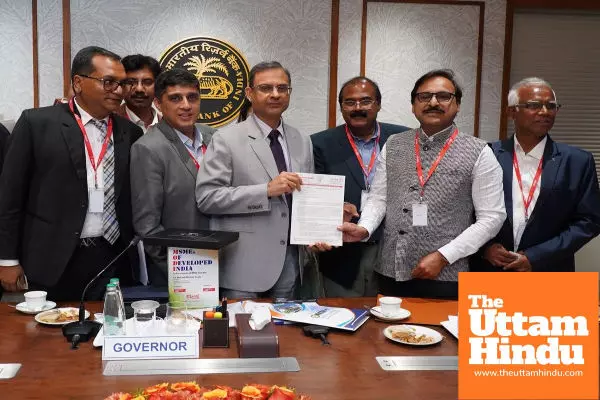
Jalandhar (The Uttam Hindu): With a special focus on the Micro, Small and Medium Enterprises (MSME) sector—considered the second engine of the Indian economy—in the Union Budget 2026–27 by the Modi government, a significant initiative has been taken in this direction. In this context, a special meeting focused on positive cooperation was held by **Reserve Bank of India Governor Sanjay Malhotra with representatives of Laghu Udyog Bharati, a leading organization representing micro and small enterprises in India.
Sharing details of the meeting, Laghu Udyog Bharati National Vice President Advocate Arvind Dhumal said that the meeting was attended by the organization’s Haryana General Secretary Manoj Roongta (CA), Maharashtra President Amit Ghaisas, Mass Communication Board Convener Atit Agrawal, and other distinguished members. After detailed deliberations in this high-level meeting chaired by Sanjay Malhotra, a memorandum was submitted incorporating solutions to suggestions gathered from across the country.
Providing details of the points included in the memorandum, Mass Communication Board North-West Region Head Vikrant Sharma stated that it called for the creation of a dedicated MSE Credit Monitoring Cell; review of loans under the CGTMSE scheme; permission for micro and small entrepreneurs to shift their loans from one bank to another without any penalty charges; revision of working capital loan norms by increasing the current limit of 20 percent of turnover to 30 or 40 percent; and introduction by the RBI of a common loan agreement framework across all banks and NBFCs for micro and small industries to ensure uniformity in credit, financing, and settlement terms.
The memorandum further demanded that SIDBI (Small Industries Development Bank of India) should open branches across the country, especially in Tier-2 and Tier-3 cities and industrial clusters, to ensure that quality MSEs receive fast, affordable, and easily accessible finance. It also sought an increase in the concessional loan limit for financing solar systems from ₹2 crore to ₹5 crore.
In line with the emphasis on sustainable manufacturing and circular economy practices in the Union Budget 2026, the RBI was urged to introduce green and manufacturing incentives through priority lending norms for micro and small units engaged in green energy, precious metal recycling, and sustainable manufacturing activities.
Like public dashboards such as Jan Shakti or Jan Dhan, the RBI should create a centralized public portal displaying complete data on credit facilities extended to micro and small enterprises by all financial institutions. It was also proposed that banks, NBFCs, and all financial institutions be mandated to record, disclose, and periodically report the reasons for rejection of loan applications, particularly those submitted by micro and small enterprises.
Similar to support provided to farmers, a bank loan interest subsidy scheme should be introduced for well-performing micro and small industries. The RBI should conduct awareness campaigns regarding its schemes, make this mandatory for state PSUs as well, and ensure strict monitoring. The margin money demanded for issuing bank guarantees should be reduced. Experienced entrepreneurs above 60 years of age with viable business ideas should not be discouraged solely on the basis of age.
Relaxation in NPA norms should be provided for micro and small manufacturing industries, especially manufacturing units, by extending the IRAC classification period from the existing 90 days to 120–180 days. A framework should also be introduced to facilitate easy release of assets in cases where banks are holding excess collateral or assets.
Special attention should be given to MSMEs in receivable settlements under the National Company Law Tribunal, to ensure their survival and prevent cascading closures. MSME receivables should be accorded priority status, ideally treated at par with government dues, so that settlements are ensured before other unsecured creditors. The memorandum also covered issues related to international trade, including special schemes for exporters, packing credit, and enhanced interest benefits.
The meeting concluded with assurances that appropriate steps would be taken expeditiously in this regard.
- Tags
- #MSME
- #RBIPolicy