
Resting centres for gig workers; food and basic amenities under one roof: CM Rekha Gupta
Delhi CM Rekha Gupta announces resting centres for gig workers, expansion of Atal Canteens, and housing for 717 families as Delhi Urban Shelter Improvement Board clears major urban welfare and infrastructure projects.
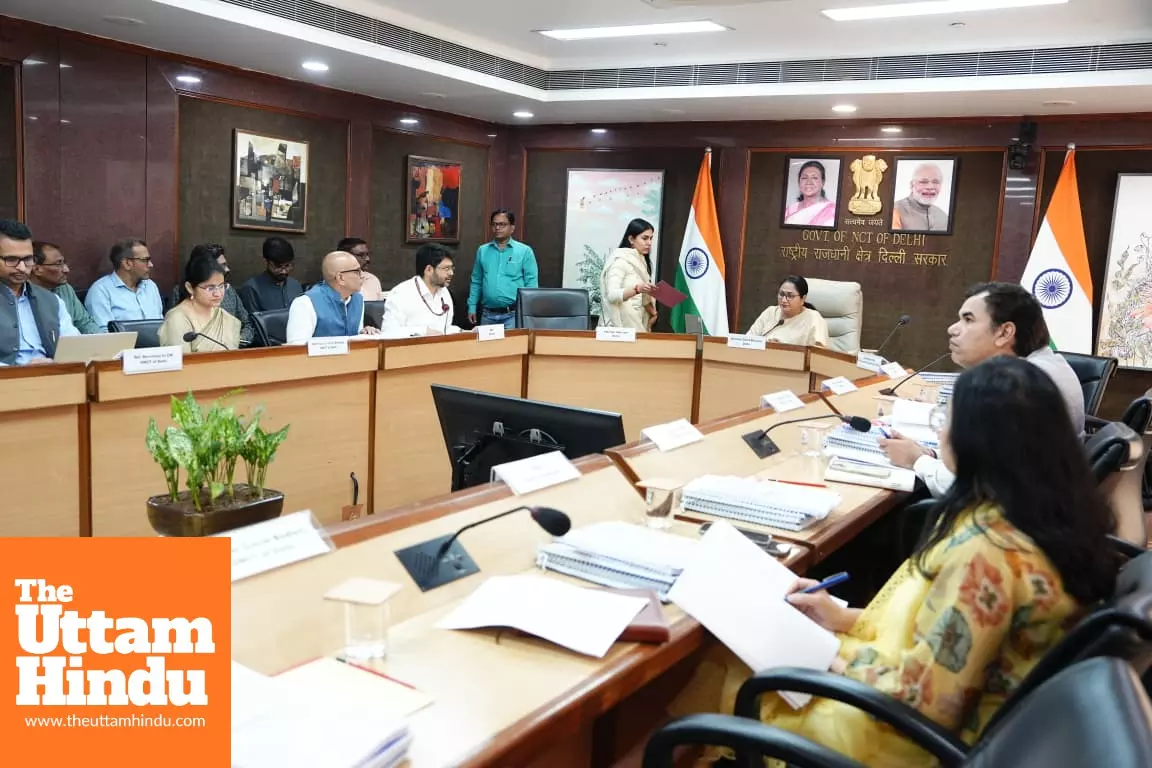
New Delhi (The Uttam Hindu): Delhi Chief Minister Smt. Rekha Gupta chaired the 35th board meeting of the Delhi Urban Shelter Improvement Board (DUSIB) at the Secretariat, where a series of decisions were taken on slum rehabilitation, welfare of gig workers and labourers, and strengthening basic urban infrastructure. Emphasising the government’s broader vision, Gupta said the aim is to ensure dignified housing, access to food, and an improved quality of life for every needy citizen. She added that the government is working towards building an inclusive urban system that makes life easier, particularly for workers and vulnerable sections.
New initiative for gig workers
A key highlight of the meeting was a new initiative for gig workers and labourers. The Chief Minister directed officials to develop resting centres and public utility hubs across the city, which will be integrated with Atal Canteens. These centres are intended to provide food, rest and essential services under one roof. In several locations, urinal facilities will also be created specifically for gig workers. Officials have been asked to identify and notify suitable sites for these facilities. Notably, the idea of resting centres emerged directly from interactions between the Chief Minister and gig workers, and Gupta has not only incorporated the suggestion into policy planning but also pushed for its swift implementation.
Atal Canteens to be revamped
The Atal Canteen scheme will see changes in both structure and operations. A total of 100 canteens and distribution centres are being reorganised, while a target has been set to establish 100 new canteens. Operating hours have been revised — lunch will be served from 10:30 am to 2:00 pm, and dinner from 6:00 pm to 9:30 pm, with an additional 30-minute buffer before service begins. To streamline operations, agencies will be provided with additional user IDs and passwords, and data collected through facial recognition systems will be retained for no more than one month.
Housing for 717 slum dwellers
On the housing front, the board approved the allotment of EWS flats in Savda-Ghevra to 717 slum dwellers. Of these, 528 fall in the eligible category, while 189 are classified as ineligible beneficiaries, drawn from a larger pool of 258 (excluding non-residential jhuggis). These beneficiaries belong to Bhai Ram Camp, Masjid Camp and DID Camp in the Race Course area. The Ministry of Housing and Urban Affairs will provide financial assistance of ₹1,12,000 per beneficiary to DUSIB, while beneficiaries will be required to deposit ₹30,000 towards maintenance within three months. In addition, 221 beneficiaries from four previously cleared slum clusters — Indira Camp (Kalyanpuri), G-Point (Gol Market), New Sanjay Camp (Okhla) and Rajiv Camp (Mandawali) — will also be allotted flats in Savda-Ghevra.
Infrastructure and repair works get a push
The meeting also cleared several infrastructure and repair projects aimed at improving living conditions. This includes repair work for 1,060 (G+4) EWS flats at Sultanpuri’s Site A-3, making 980, 736 and 288 five-storey housing units in Dwarka Sector 16-B habitable, and developing roads, parks, sewer systems and pathways for 7,400 flats in Bhalswa (Jahangirpuri Pocket-II).
Administrative decisions and review
In a significant administrative move, the financial approval limit of the DUSIB CEO has been enhanced from ₹3 crore to ₹10 crore to expedite project execution. The tenure of existing agencies managing shelter homes has also been extended till May 31, 2026, or until new agencies take charge.
The Chief Minister further directed DUSIB to prepare a detailed report on its work over the past year to assess impact, track progress and identify areas needing improvement. She stressed that all schemes must be implemented in a time-bound, transparent and effective manner to ensure tangible benefits reach slum dwellers, workers and other vulnerable groups. “The goal is not just to roll out schemes, but to make sure they translate into real change on the ground,” Gupta said, reiterating the government’s commitment to building a more inclusive and dignified urban environment.