
Boiling water and toxic gases… Earth’s hottest and most dangerous place ‘Dallol’ is full of mysteries
Discover Dallol in Ethiopia, one of the hottest and most dangerous places on Earth, with boiling acidic water, toxic gases, and life thriving in extreme conditions.
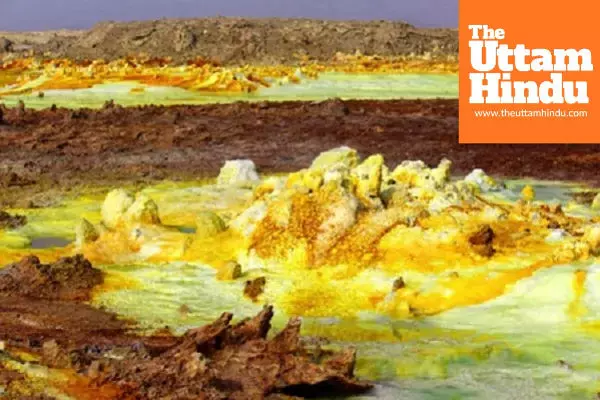
New Delhi (The Uttam Hindu): There are many places on Earth where nature reveals not just beauty but also extreme danger and mystery. One such place is the Dallol region, located in the Danakil Depression of Ethiopia. It is considered one of the most dangerous and unique locations on the planet.
The region sits on a salt volcano crater and features intense hydrothermal activity. Boiling water, toxic gases, salt chimneys, and highly acidic pools are constantly active here, making it an extremely hostile environment.
According to NASA, Dallol appears visually stunning with psychedelic colors. Yellow deposits come from sulfur, red tones from iron oxide, and green shades from copper salts dissolved in water. The temperature of the superheated water can exceed 94°C, while the pH level can drop to as low as 0.25—making it extremely acidic. The area is also highly saline, with salt formations commonly seen.
A research team led by Felipe Gómez from Spain’s Astrobiology Center studied the region. Samples collected during a 2017 expedition were analyzed using electron microscopy, chemical analysis, and DNA sequencing. Surprisingly, scientists discovered extremely tiny bacteria thriving in these extreme conditions.
These microorganisms are up to 20 times smaller than typical bacteria and were found in salt deposits and acidic pools. Scientists observed spherical structures rich in carbon, indicating biological origin. This discovery raises questions about whether these organisms adapted to such harsh conditions or evolved within them.
Dallol lies about 125–155 meters below sea level and is part of a geologically active zone formed around a volcanic event in 1926. It is considered one of the hottest inhabited places on Earth, with average temperatures ranging between 34–35°C year-round. The presence of boiling springs, toxic gases like chlorine and sulfur, and extreme salinity makes human survival nearly impossible.
Despite these conditions, life exists in the form of extremophiles—organisms that survive in extreme environments. Scientists believe Dallol closely resembles ancient environments of Mars, especially areas like the Gusev Crater explored by NASA’s Spirit rover.
The region produces various minerals such as silver chloride, zinc iron sulfide, manganese dioxide, and rock salt from superheated waters. These findings are crucial for astrobiology, as they help scientists understand how life might exist beyond Earth.
Dallol remains a fascinating natural laboratory, offering insights into extreme life forms and the possibility of life on other planets.
- Tags
- #Ethiopia