
Dead Sea: lowest point on Earth where no life thrives, why it is called ‘dead’
New Delhi (The Uttam Hindu): The Dead Sea, also known as the Dead Sea, is one of the world’s most unique lakes. Its name immediately raises the question: why is it called “dead”? The answer lies in the fact that no life can survive in its waters. NASA provides detailed information about this phenomenon.
The main reason is the extremely high salinity of the water. The salt concentration is so high that fish, plants, and most living organisms cannot survive here. This is why it is called the Dead Sea. It is not a regular sea but a salt lake situated on the border of Israel and Jordan, and it is the lowest point on Earth’s surface, about 400 meters (1,300 feet) below sea level. The water here is 8–10 times saltier than normal sea water.
The high salt concentration also increases water density, allowing objects to float instead of sinking.
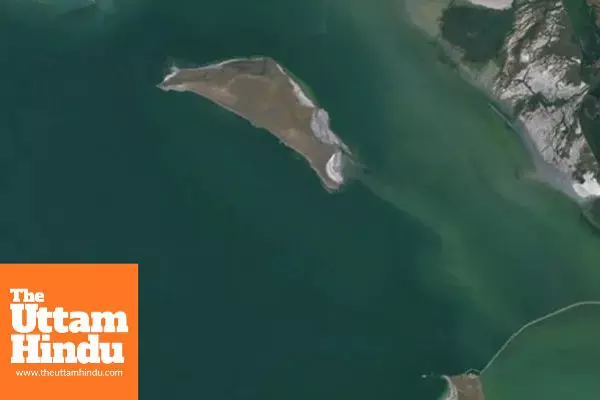
NASA’s Landsat satellite images highlight this uniqueness. Photos taken in 1972, 1989, and 2011 show deep blue water, bright blue, and light pink areas. Green and bright red patches indicate limited vegetation. The Lisan Peninsula is clearly visible, splitting the Dead Sea into two sections like a natural bridge. During hot, dry summers, water evaporates rapidly, sometimes lowering the level by 2–3 centimeters in a single day. Over decades, this has caused a significant drop in water levels.
Ancient history and industrial importance
The Dead Sea has attracted visitors and industries for thousands of years. Ancient Egyptians used its salt for preserving mummies, as fertilizer, and for making potash. Today, sodium chloride and potassium salts extracted from the Dead Sea are used for water purification, de-icing roads, and producing PVC plastics. Over the past 40 years, large-scale salt extraction projects have increased, visible even in satellite images.
Religious and historical significance
The area also holds major historical and religious value. Between 1947 and 1956, ancient manuscripts known as the Dead Sea Scrolls were discovered in caves along its northeastern shore. These include over 972 texts of the Hebrew Bible and other Jewish-Christian works, representing some of the oldest preserved scriptures—an important milestone for historians.
NASA and US geologists collaborate through the Landsat program, providing public access to images and data. Scientists use this to monitor environmental changes in the Dead Sea over time.
- Tags
- #NASA