
Finance Bill 2026 passed by Parliament, budget proposals get legal approval
Parliament passes Finance Bill 2026, giving legal approval to Union Budget 2026-27 with ₹53.47 lakh crore expenditure and focus on infrastructure and fiscal discipline.
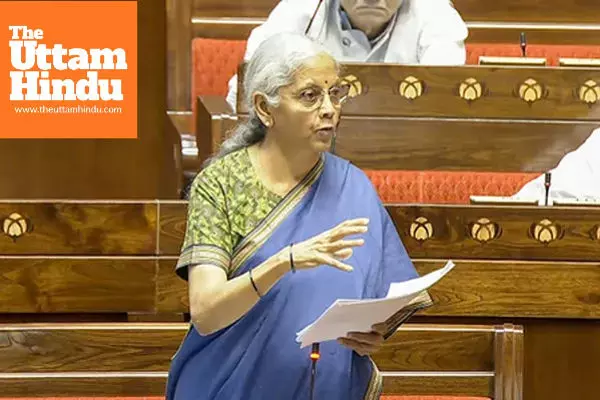
New Delhi (The Uttam Hindu): Parliament has approved the Finance Bill 2026, completing the legislative process to give legal backing to the Union Budget 2026–27 proposals, which will come into effect from April 1. The Rajya Sabha passed the bill by voice vote and returned it to the Lok Sabha.
The Lok Sabha had earlier passed the bill on March 25 with 32 amendments. After a brief discussion in the Rajya Sabha, Finance Minister Nirmala Sitharaman responded to members’ queries, following which the bill was approved.
Higher expenditure and infrastructure push
The Union Budget 2026–27 has proposed a total expenditure of ₹53.47 lakh crore, which is 7.7% higher than the current financial year ending March 31.
A capital expenditure of ₹12.2 lakh crore has been allocated for major infrastructure projects, marking an increase of ₹2.2 lakh crore compared to last year. This is expected to boost economic growth and generate employment.
The Finance Minister also announced the creation of an ‘Infrastructure Risk Development Fund’ to accelerate the completion of large projects.
Fiscal deficit target and borrowing plan
The government has set a fiscal deficit target of 4.3% of GDP for 2026–27, aiming to maintain financial stability while supporting economic growth.
To bridge the deficit, the government plans net borrowing of ₹11.7 lakh crore in FY2027, with total market borrowing estimated at ₹17.2 lakh crore.
Focus on key sectors and financial discipline
The budget emphasizes strengthening infrastructure sectors such as highways, ports, railways, and power, along with boosting manufacturing in seven strategic sectors and promoting MSMEs.
The Finance Minister stated that the government remains committed to fiscal discipline and monetary stability while maintaining strong public investment.
India’s debt-to-GDP ratio has declined to 56.1% in FY2025–26, with a target to further reduce it to 55.6% in FY2026–27. A lower ratio is expected to reduce interest burden and free up resources for development activities.