
ISRO to launch its ‘Bahubali’ into space tomorrow, 5G internet will work even between mountains and seas without towers
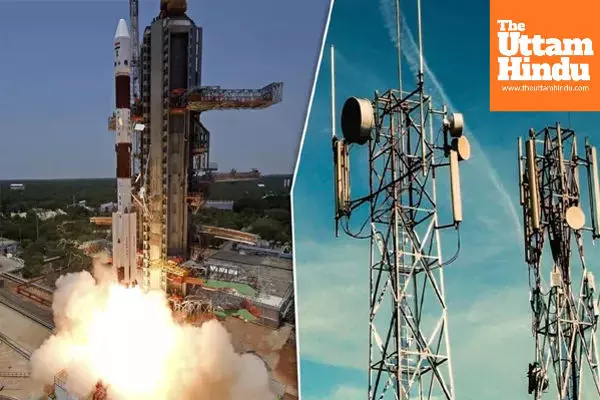
Sriharikota (The Uttam Hindu): The Indian Space Research Organisation (ISRO) is set to create history on Wednesday by launching a mission that could transform the way people access mobile connectivity. ISRO will launch the “BlueBird Block 2” satellite at 8:54 am from the Satish Dhawan Space Centre in Sriharikota using its heaviest and most powerful rocket, LVM-3 (LVM3-M6), popularly known as ‘Bahubali’.
The key highlight of this mission is that the satellite will function like a mobile tower in space. Once operational, it will help eliminate network problems in remote areas such as mountain regions, dense forests, deserts and even the middle of the sea, where traditional mobile towers are not feasible.
A mobile tower in space
Developed by US-based company AST SpaceMobile, the BlueBird Block 2 satellite is very different from conventional satellites. After reaching low-Earth orbit, it will deploy a massive 223 square metre phased-array antenna, making it the largest commercial communication antenna ever placed in low orbit. Weighing around 6,500 kg, the satellite is designed to work as a powerful space-based cell tower.
The biggest advantage of this technology is that users will be able to receive signals directly on their regular 4G and 5G smartphones, without the need for satellite phones or additional equipment.
How the technology works
When a smartphone moves out of the range of ground-based mobile towers, it will automatically connect to the BlueBird satellite network in space. The satellite can capture even weak signals from mobile phones and relay them to ground gateway stations, which then route calls and data through existing mobile networks. The system is capable of delivering internet speeds of up to 120 Mbps, enabling smooth calling and video streaming even in remote locations.
Another major India–US space collaboration
This mission is another strong example of growing space cooperation between India and the United States. Earlier this year, ISRO collaborated with NASA on the NISAR mission. The upcoming launch will be the ninth mission of the LVM-3 rocket, ISRO’s 101st overall launch, and the fifth mission of the Indian space agency in 2025.
Initially, the service is expected to cover the United States, with plans for global expansion later. If successful, the mission could bring mobile connectivity to some of the most inaccessible parts of the world where installing towers has so far been impossible.