
Narendra Modi flags off Namo Bharat train, Delhi–Meerut journey now just 55 minutes
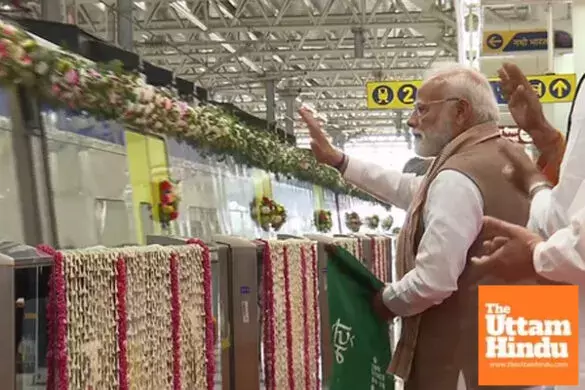
Meerut (The Uttam Hindu): Prime Minister Narendra Modi on Sunday flagged off the Meerut Metro and the Namo Bharat Train at the Shatabdi Nagar Namo Bharat station, giving a major boost to the government's efforts to strengthen regional connectivity and urban transport in the National Capital Region (NCR).
Upon his arrival in Meerut, PM Modi was welcomed by Uttar Pradesh Chief Minister Yogi Adityanath and BJP state unit president Pankaj Chaudhary. Afterward, PM Modi arrived at the Shatabdi Nagar Namo Bharat station and flagged off the metro and train.
The Prime Minister dedicated the 82-km-long Delhi-Meerut Namo Bharat Corridor to the nation. He also inaugurated the remaining sections of the RRTS, including the 5-km stretch from Sarai Kale Khan to New Ashok Nagar in Delhi and the 21-km stretch from Meerut South to Modipuram in Uttar Pradesh.
He also rode the metro to Meerut South station and interacted with passengers and students on board. During this time, two students showed Prime Minister Modi some photographs.
With speeds of up to 180 kilometers per hour, Namo Bharat is India's first regional rapid transit system. Namo Bharat will provide faster connectivity to major urban centers such as Sahibabad, Ghaziabad, Modinagar, and Meerut from Delhi.
Sarai Kale Khan, the corridor's starting station, is one of four Namo Bharat stations to be launched with this inauguration. It is strategically located as a major multi-modal hub, providing easy access to Hazrat Nizamuddin Railway Station, the Delhi Metro's Pink Line, Veer Hakikat Rai ISBT, and the Ring Road. The other three Namo Bharat stations to be launched are in Shatabdi Nagar, Begumpul, and Modipuram, Meerut.
This seamless integration of the Namo Bharat and Meerut Metro on a single infrastructure will enable high-speed inter-city travel and smooth intra-city mobility, setting a precedent for integrated urban and regional transport in India. This will reduce road traffic congestion and, consequently, significantly reduce vehicular carbon dioxide emissions.