
Safety pin's tiny hole: Not just design, but brilliant engineering, know the interesting detail
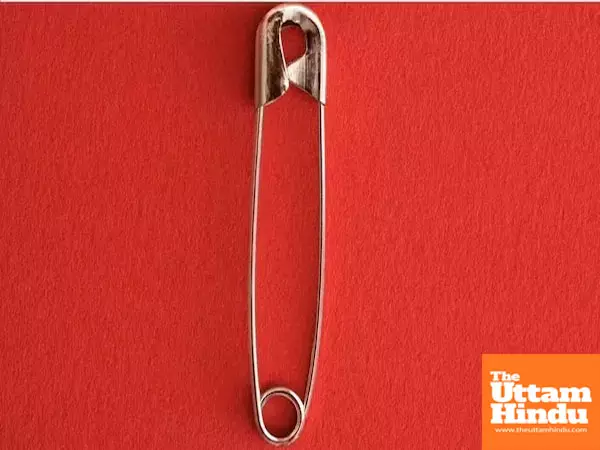
New Delhi (The Uttam Hindu): Safety pins are an item readily available in almost every household. From joining clothes to emergency rescues, we use them extensively in our daily lives. But have you ever wondered why safety pins have a small circular hole at the bottom? People often assume it's just a design and use it without a second thought. But the reality is that this seemingly small hole isn't just for decoration, but the result of extremely clever engineering, without which the pin would be useless.
The journey began in the Bronze Age and took its modern form in 1849
The history of the safety pin dates back centuries. In ancient times, it was called "fibula" in Latin, and it is believed to have been used in Europe during the Bronze Age. At that time, its primary function was to hold clothing in place. However, the safety pin we use today was invented in 1849 by Walter Hunt. He created a spring mechanism by bending a single wire, which later became the hallmark of the modern safety pin. Previous pin manufacturing methods were complex, requiring two separate parts, and were not convenient to use.
This is not a hole, this is the science of 'spring'
If you look closely at a safety pin, you'll notice that the wire at the bottom is twisted into a coil, which we perceive as a hole. This part actually acts as a spring. In engineering terms, this circular design helps maintain the correct angle and tension of the wire. This tension keeps the pointed end of the pin firmly locked into the groove at the top. If the safety pin didn't have this spring and that small hole, the pin wouldn't generate tension and would repeatedly open on its own. This would not only destroy its ability to hold clothing, but would also increase the risk of injury if it opened.
Simple design hides extraordinary understanding
A wire pin was previously used in Central Europe, Greece, and Italy, but Walter Hunt's design perfected it. This design is so effective that even after 150 years, it hasn't required any major changes. The safety pin may appear to be a simple piece of wire, but its creation is the result of decades of understanding and experimentation. A small hole, a spring, and a wire combine to make it a reliable tool that remains a vital part of our everyday needs.