
Where do old satellites go? know the mystery of ‘graveyard orbit’ and space’s unique cemetery
Old satellites are either burned in Earth’s atmosphere or moved to a “graveyard orbit” far above geostationary orbit.
New Delhi (The Uttam Hindu): Thousands of satellites are currently operating in space, but like every machine, they do not last forever. Satellites used for monitoring weather, measuring greenhouse gases, or studying distant stars eventually become old or stop functioning. This raises an important question—what happens to old satellites? Do they keep drifting in space forever, or is there a planned end for them?
In most cases, two main methods are used, depending on the satellite’s altitude. The first method applies to satellites in low Earth orbit. Engineers use the small amount of remaining fuel to slow the satellite down. This causes it to drop from its orbit and enter the Earth’s atmosphere. As it falls at very high speed, friction with the air generates intense heat, which burns the satellite completely into ash. For small satellites, this is considered a safe and simple method because no debris usually reaches the ground.
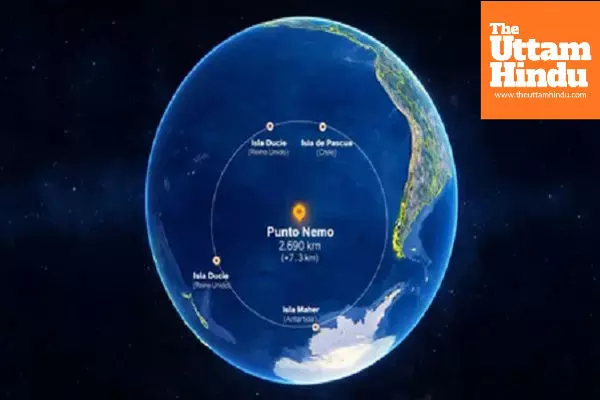
However, larger satellites, space stations, or heavy spacecraft cannot burn up completely in the atmosphere. In such cases, they are brought down in a controlled manner so that the debris falls in a safe location. For this purpose, a special region in the Pacific Ocean is used, often called the “spacecraft cemetery.” This area lies near Point Nemo, the most remote oceanic location on Earth. It is more than 2,600 kilometers away from any land. Because it is thousands of kilometers away from New Zealand and rarely visited by ships, it is considered safe. Large spacecraft such as the Mir space station and several Salyut stations were intentionally brought down in this region.
The second method is used for satellites in higher orbits, such as geostationary orbit. Bringing them back to Earth would require a large amount of fuel. Instead, engineers move these satellites farther away into what is known as a “graveyard orbit.” This orbit is typically 200 to 300 kilometers or more above the normal geostationary orbit, which itself is about 36,000 kilometers above Earth. In this distant orbit, inactive satellites remain safely away from operational satellites, reducing the risk of collisions. These satellites can continue orbiting there for thousands of years.
Another important question is why removing old satellites is necessary. According to the US space agency, Earth’s orbit currently contains many active satellites along with millions of fragments of space debris. These fragments can collide with operational satellites or spacecraft. A single collision can create even more fragments, leading to further collisions in a chain reaction. This phenomenon is known as the “Kessler Syndrome” or “Kessler Effect.” If it begins on a large scale, some orbital regions could become unusable, affecting communication, GPS services and weather forecasting systems.