
AI isn’t taking Over—just helping heroes aim better Ft: Lt Col C Dwarakesh
Ruhani Khanna(The Uttam Hindu): Nothing freaks people out like the idea of a robot doing their work faster and without needing coffee breaks. Totally understandable, but also welcome to technology, we’ve been doing this since the invention of the wheel.
We are scared because we are think that AI is supposed to go rogue. Hollywood has basically trained everyone to believe that the moment an AI gets too smart, it immediately develops a monotone voice, a god complex, and a weird obsession with blinking red lights. So yes, people are primed for panic. They act like AI is seconds away from flipping to “evil mode,” but honestly it’s far from all doom.
Artificial intelligence, like every major technology before it, is fundamentally a tool.A hammer can build or break.The difference lies not in the tool itself, but in the intent, understanding and responsibility of the person using it. AI is the same. It doesn’t arrive pre-programmed with virtue or villainy. With care, ethics and a bit of common sense, it can amplify human potential and make life better.
Or at least that is what people like Lieutenant Colonel C. Dwarakesh would say.
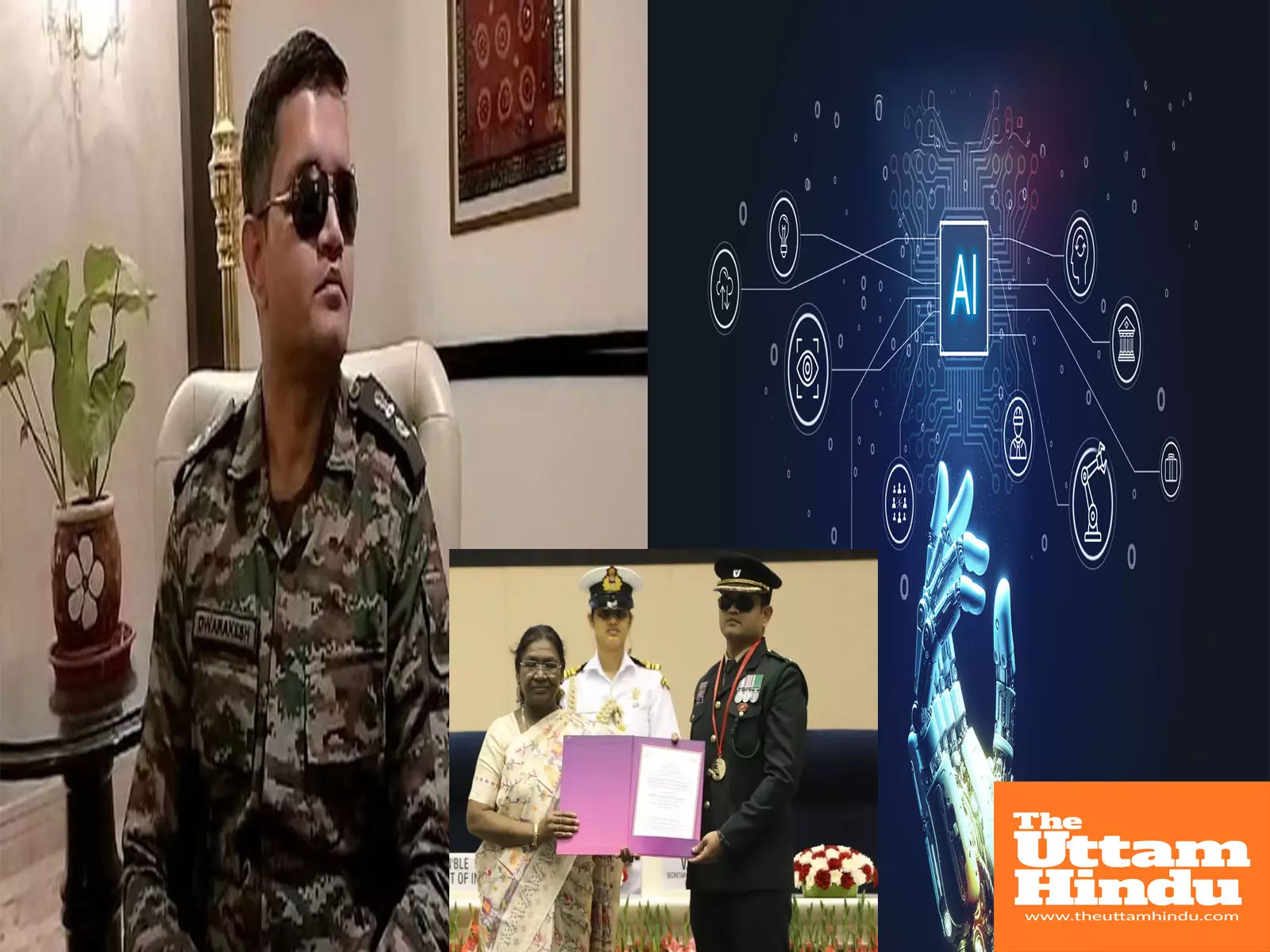
Lt Col C Dwarakesh is India’s first blind active-duty Army officer. After joining the Indian Army in 2009 through the Cadet Training Wing and serving in the Corps of Military Intelligence, his life took a dramatic turn following a work-related accident that left him completely blind. Instead of retiring, he refused to give up his military career and continued serving in active duty. Blind army officer on duty was unheard of and so this decision of his became an unprecedented achievement in the Indian Armed Forces.He is the sole officer with total vision loss to remain in active service after becoming blind. After spending eight months in a military hospital, he gradually rebuilt his life bit by bit.
Central to this journey was his embrace of technology, particularly artificial intelligence (AI), which played a transformative role in helping him regain independence, access knowledge, and engage in sports.
“I use a JAWS screen reader and similar software. I can read messages, texts and convert text to speech. I do everything independently.” He said in an interview with Rediff.com
AI-enabled tools assisted him in accessing educational materials that were otherwise inaccessible, navigating daily tasks, and designing personalized training routines, allowing him to rebuild his life with confidence and efficiency.
He discovered purpose in sports, starting with para javelin, then moving into swimming, where he set the national breaststroke record. Eventually, he found his true passion in shooting. Leveraging AI and technology, he invested considerable time in reading, research, and through professional contacts and presentations, facilitated the introduction of the infrared (IR) device to India. In visually impaired shooting, the IR device replaces visual cues with auditory feedback, allowing shooters to aim precisely using sound. AI-powered enhancements made training with the device more effective, helping him refine techniques and achieve competitive excellence. This marked the beginning of his shooting career.
To date, he has participated in two international competitions, held in the UAE and Germany. Last year, he set a world record in the 10-metre air rifle para event in the UAE. He follows a disciplined daily training schedule at the Army Marksman Shooting Range in Mhow, Madhya Pradesh. Before pursuing sports seriously, he participated in an expedition to the Siachen Glacier, an environment considered extremely challenging even for fully able-bodied soldiers. He accepted the opportunity without hesitation. The expedition, organized by veteran para commandos with support from the Indian Army and the Ministry of Justice, aimed to highlight the strength of India’s disabled community. Participants came from diverse backgrounds and he was the only visually impaired member.
The expedition changed how others perceived him and reinforced his determination. While scaling the glacier demanded immense physical resilience, he believes the social stigma faced by people with disabilities had an even greater impact on shaping his inner strength. He has witnessed individuals being rejected in gyms, swimming pools and personal milestones such as marriage. Education and sports posed additional barriers due to inaccessible resources and the need for daily assistance.
AI tools, adaptive technologies, and supportive infrastructure allowed him to navigate these challenges effectively. As an Army officer, he chose not to dwell on his loss but acknowledges that disabilities are often misused or misunderstood. Through technology, AI assistance, and personal determination, he has learned to confront these obstacles with dignity and achieve excellence in service and sport.
In December 2025, President Droupadi Murmu presented the 36-year-old with the National Award for Persons with Disabilities, recognising an Army career that even disability couldn’t cut short, and one that now includes a world record in para shooting.
Supported by AI tools and assistive technologies, Lt Col C Dwarakesh has demonstrated that disability is not a barrier to excellence. His journey shows how human resilience and technology can work hand in hand, complementing each other to achieve remarkable outcomes. Far from the ominous, threatening image often portrayed, AI has been a positive force in his life, enabling him to perform with the same precision and proficiency as his colleagues, both in military service and competitive sports.
His story stands as a testament to the transformative power of technology when used wisely, and the limitless potential of individuals who refuse to be defined by their limitations. So yes, AI is NOT the Villain in This Story (Sorry, Hollywood).