
'15 minutes can save a life': How Punjab's hi-tech ambulances are rezching pztients in time when every minute matters
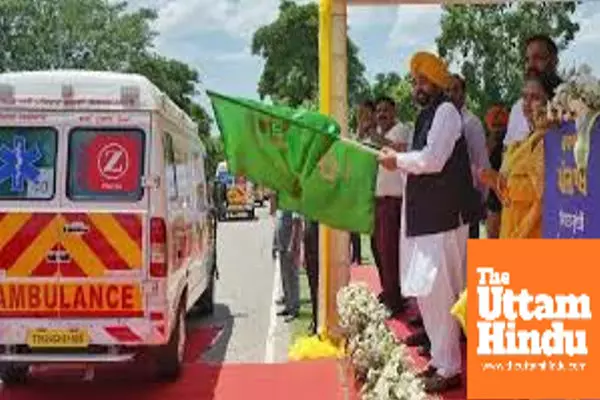
Punjab (The Uttam Hindu): Punjab’s hi-tech ambulance network is emerging as a lifeline, reaching patients within 15 to 20 minutes, even in the state’s most remote villages. As Chief Minister S. Bhagwant Singh Mann has stated, the mission is clear: “Protect every Punjabi’s life through faster response, trained paramedics, and mobile ICU care.”
For millions of residents across Punjab, a medical emergency no longer means fear, confusion, or long delays. With just a phone call, a hi-tech ambulance arrives at the doorstep within minutes. In 2025, Punjab significantly reinforced its emergency healthcare system by expanding its fleet of advanced ambulances.
Among the most appreciated initiatives is the 24/7 toll-free 108 helpline. A single call activates a coordinated response involving central control rooms, GPS-enabled tracking, trained paramedics, ambulances, and hospitals, all working together seamlessly. At present, Punjab has deployed 371 ambulances, including 46 newly inducted hi-tech vehicles that were recently flagged off by Health and Family Welfare Minister Dr Balbir Singh. Of these, seven ambulances have been dedicated as “Child Memorial Ambulances” in Samana (Patiala), paying tribute to children who lost their lives in a tragic road accident earlier this year.
Emergency care where hospitals can’t reach
Distance has long posed a serious challenge to Punjab’s healthcare delivery. Many villages lie far from tertiary hospitals, and in emergencies, every additional kilometre can mean the difference between life and death. Delays in medical intervention during accidents, heart attacks, and pregnancy-related emergencies have frequently resulted in fatal outcomes.
The rollout of hi-tech ambulances has begun to bridge this tong-standing gcp
Unlike conventional ambulances, these vehicles operate as mobile intensive units. equipped with oxygen systems, cardiac monitors, defibrillators, ventilators, emergency trauma kits, enabling medical treatment to begin immediately rather then until the patient reaches a hospital.
For residents in remote and rural areas, this has proven to be transformative. Highly trained paramedics now reach villages swiftly, stabilise patients at the scene, and continue treatment during transit to healthcare facilities.
Faster response, even in traffic-choked cities
In urban centres such as Ludhiana, Amritsar, and Jalandhar, heavy traffic has traditionally delayed emergency response. To counter this, Punjab's hi-tech ambulances are fitted with advanced GPS tracking systems and are directly linked to central control rooms.
This integrated system allows ambulances to take the fastest possible routes, ensuring response times of around 15 minutes in cities and 20 minutes in rural areas. These benchmarks place Punjab among the fastest emergency response systems in the country, marking a significant achievement in public healthcare delivery.
Punjab CM S. Bhagwant Singh Mann welcomed the move
In 2024, the Chief Minister of the province of Punjab, S. Bhagwant Singh Mann, flagged off 58 hi-tech ambulances in the administrative centre of Chandigarh. "These ultra-modern ambulances have been mandated to reach needy patients within 15 minutes in urban areas and 20 minutes in rural areas," CM Mann said at the launch. He added, "The 58 hi-tech ambulances have been purchased for Rs 14 crore and are equipped with life-saving drugs and ultra-modern equipment. These ambulances will act as a catalyst to provide primary treatment so that lives are saved well in time."
Not just vehicles, but trained hands behind the wheels
While technology plays a vital role, it is skilled human intervention that ultimately saves lives. Every hitech ambulance is manned by trained emergency medical technicians and paramedics who undergo regular training in trauma management, cardiac care, maternal health, and paediatric emergencies. This continuous upskilling ensures that sophisticated medical equipment is used efficiently when every second counts. In addition, the ambulance teams work in close coordination with the Sadak Surakhya Force (SSF), especially in cases of road accidents. This coordinated response has led to a notable reduction in fatalities by enabling immediate medical assistance at accident sites and faster patient evacuation.
The scale of impact so far
Since its launch in 2011, the 108 Ambulance Service has provided emergency assistance to over 30 lakh people across Punjab. Emphasising its importance, Health and Family Welfare Minister Dr Balbir Singh said, "The 108 service is the backbone of our emergency healthcare system. With these new ambulances, we are ensuring that no call for help goes unanswered.