
Inside Punjab's new hi-tech ambulances: Facilities, number deployed, and emergency reach time
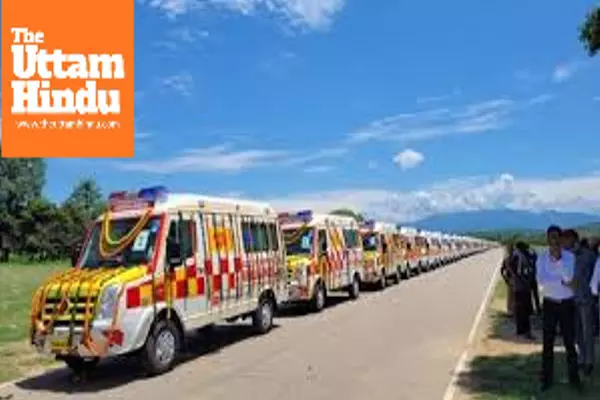
Punjab (The Uttam Hindu): Punjab has taken a major step toward strengthening its emergency healthcare system by launching new hi-tech ambulances across the state. These ambulances are fitted with modern lifesaving equipment, including oxygen support, GPS tracking systems, and other advanced facilities. The initiative aims to ensure that emergency services reach patients within 15 minutes in urban areas and within 20 minutes in rural villages, thereby enhancing critical medical care at the grassroots level.
The Punjab Government described the rollout of these ambulances as a milestone in emergency medical services. Officials noted that the introduction of technologically advanced vehicles is expected to improve survival rates while significantly reducing response times for people facing medical emergencies across Punjab.
On June 13, 2025, Punjab's Minister of Health and Family Welfare, Dr Balbir Singh, formally approved the deployment of 46 new ambulances equipped with advanced medical technology. The approval underscored the state government's ongoing commitment to ensuring that the people of Punjab receive high-quality and timely medical care when they need it most.
With these additions, from 356 ambulances (331 Basic Life Support Ambulances and 25 Advanced Life Support), the state's total fleet has grown to 371 ambulances, strengthening the healthcare system's capacity in both planned and unforeseen crises.
Punjab Chief Minister S. Bhagwant Singh Mann officially unveiled 58 brand-new, state-of-the-art ambulances in Chandigarh in 2024. Punjab Health Minister Balbir Singh stated during the inaugural ceremony that these advanced ambulances are a part of an effort to increase the state's citizens' access to healthcare.
"These ultra-modern ambulances have been mandated to reach the needy patients within 15 minutes in urban areas and 20 minutes in rural areas," the Chief Minister said.
Equippedfor life-saving response
According to the Health Minister, the newly inducted ambulances come fitted with state-of-the-art medical equipment, including oxygen supplies, ambu-bags, essential life-saving drugs, and GPS-enabled tracking systems to ensure rapid response.
Dr Singh highlighted the importance of quick action during emergencies, saying, "Our goal is to further reduce response times to 10 minutes, ensuring critical care reaches patients within the golden hour."
This commitment to acceleration in emergency response—aiming for a target well within international standards—reflects the government's larger plan to make emergency care more effective in both urban and rural areas. Currently, the ambulances aim to reach distress calls within 15 minutes in cities and 20 minutes in countryside regions.
Among the newly added vehicles are seven specially designated "Child Memorial Ambulances." These ambulances have been dedicated in remembrance of children who lost their lives in a tragic road accident in Samana (Patiala) earlier this year. Officials stated that the initiative serves a dual purpose—honouring the memory of the young victims while also strengthening emergency medical services in areas where rapid response is crucial.
Dr Balbir Singh underlined the importance of the 108 Ambulance Service, describing it as the cornerstone of Punjab's emergency healthcare framework. He said, "The 108 service is the backbone of our emergency healthcare system. With these new ambulances, we are ensuring that no call for help goes unanswered.
Since being launched in 2011, the 108 ambulance network has provided assistance to more than 30 lakh citizens. Its services cover a wide range of emergencies, including road accidents, cardiac emergencies, maternal cases, trauma incidents, and other medical crises.
Deployment across the state
The upgraded ambulance fleet has been strategically deployed across multiple districts to enhance emergency response at the local level. The distribution spans both major cities and smaller towns, with ambulances positioned in places such as Ludhiana, Patiala, Gurdaspur, Faridkot, Bathinda, Muktsar Sahib, and other locations across the state.
What this means for residents
For residents of Punjab, the expansion translates into faster response times, better-equipped ambulances, and improved access to advanced lifesaving care, particularly in areas that previously faced service gaps. The impact on maternal healthcare has been especially notable, with 3,617 successful deliveries conducted inside ambulances by trained Emergency Medical Technicians since 2011.
The service remains completely free of cost for all citizens. In the event of any medical emergency, residents can dial 108 at any time to receive immediate medical assistance.