
Remembering Pt. Ajja Ram Prem: A pioneer of ethical hindi journalism
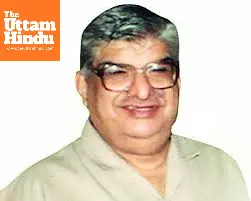
Punjab (The Uttam Hindu): Devbhoomi Himachal has given birth to a few such great sons who not only played an important role in every sphere of society but also glorified their motherland and shouldered the responsibility of giving a new direction to society — a mission in which they were largely successful. Although this great soul is no longer among us today, his memories remain permanently etched on the canvas of our minds and will continue to live on for generations. One such eminent personality was Pandit Ajja Ram Prem.
The very mention of his name immediately draws attention toward the pen, because this master of words, through the strength of his writing, not only served society but also became a support and guide for countless young people walking the path of journalism. The position he achieved after struggling through difficult circumstances stands as a shining example of his capability and dedication.
During his long journey in journalism, Pandit Ji did not consider it sufficient merely to follow traditional goals; instead, he made it his duty to prepare and guide young journalists to move forward in this direction with complete awareness. Even today, many individuals working in newspapers across the country owe their beginnings to him.
Pandit Ajja Ram Prem was born on 10 July 1938 in village Bathra, under Dehra Gopipur tehsil of Kangra district, Himachal Pradesh. His life is the inspiring story of an ordinary man who endured continuous struggles. He was extremely sensitive, a man of deep emotions, and a thoughtful writer and creative author.
He authored and edited the book “Patrakar” (Journalist), through which he made a remarkable effort to provide journalists with a new path, modern techniques, and writing styles. He is believed to be among the first journalists of Punjab and Himachal Pradesh to introduce the tradition of illustrated feature writing in journalism.
By visiting the huts of the poor and drawing from their lived experiences, he vividly portrayed the pain, suffering, and realities of common people through his sharp writing and commentaries, reaching society through newspapers and stirring the conscience of millions.
A studious individual since childhood, Pandit Ji worked 12 to 14 hours a day in his village, yet still found time to pursue his education and attain higher studies. Later, under the influence of several scholars, he moved to Amritsar, where alongside his studies he began teaching to support himself.
In 1962, he entered journalism as an Amritsar correspondent for Dainik Veer Pratap and Dainik Veer Arjun (Delhi). During the 1965 Indo-Pak war, he served with distinction as a war correspondent in the border areas.
In 1968, he moved to Dharamshala, working as a correspondent for Dainik Hindi & Urdu Milap, Dainik Punjab Kesari, Hind Samachar, and also for All India Radio Shimla and Jalandhar. Eventually, he was appointed Deputy Editor of Punjab Kesari and later retired honorably from the post of News Editor, owing to his dedication and tireless hard work.
Apart from this, his writings were published in numerous newspapers and magazines such as Dharmyug, Saptahik Hindustan, Kadambini, Navneet, Dinman, Yojana, Ravivar, Kurukshetra, Haryana Samvad, Himprast, Urdu Pratap, Tej, Ajit, Punjabi Digest, and many others. Several of his articles were also published in other Indian languages and foreign journals.
His talks were broadcast on Jammu, Jalandhar, and Shimla Radio, and his plays were telecast on Jalandhar Doordarshan. His illustrated and heart-wrenching articles on war widows deeply shook the entire nation. Some of his articles published in Dharmyug and Saptahik Hindustan were serious enough to prompt discussions in Parliament and Legislative Assemblies.
Late Pandit Ajja Ram Prem authored essay collections such as “Adarsh Nibandh” and children’s story collections like “Amar Deep”. He also wrote the book “Patrakar” to guide aspiring and working journalists. At that time, no other Hindi book provided such comprehensive knowledge on journalism, especially when publishing books itself was extremely difficult.
For his contributions to journalism, he was honored with the prestigious “Matrashree Award” in 1982. From 1986 to 1987, he served as a member of the Jalandhar Telephone Advisory Committee. He also remained a trustee of the Chintpurni Temple Trust in Himachal Pradesh for a long time.
Along with journalism, he was actively involved in social service. He never forgot the soil in which he grew up. After passing eighth grade, he helped establish a school in his village Bathra, which today stands like a banyan tree, providing education up to 10+2 level to countless children. He also made significant contributions to building roads, dispensaries, and postal facilities in the village — efforts that resulted in regular bus services operating there today.
During his journalistic career, he came into contact with many political leaders who acknowledged his clarity of thought and ideology. Being a resident of Himachal Pradesh, he maintained a keen interest in state politics and held a special inclination toward the principles of the Rashtriya Swayamsevak Sangh and the Bharatiya Janata Party.
Despite failing health, he remained active in journalism until the very end. Drawing upon his vast experience, he wished to guide the future generation of journalists toward a new direction. This dream took shape after his retirement, but before it could fully materialize, he departed from this mortal world on 10 January 1992.
With his sudden demise, an era of journalism in North India came to an end, and the world of newspapers lost an experienced, dedicated, and battle-hardened journalist.
On this occasion, we bow in reverence to his memory.
— Virant Sharma (1930–2001)