
Union Agriculture Minister Shivraj Singh Chouhan inaugurates three-day National Pusa Krishi Vigyan Mela
New Delhi (The Uttam Hindu): On February 25, 2026, while inaugurating the three-day Pusa Krishi Vigyan Mela at the Indian Agricultural Research Institute in New Delhi, Union Minister for Agriculture & Farmers’ Welfare and Rural Development Shri Shivraj Singh Chouhan unveiled a comprehensive roadmap of major agricultural reforms aimed at steering farming toward “Developed Agriculture–Self-Reliant India.”
He made it clear that the old practice of withholding farmers’ payments would no longer continue. From MSP procurement to KCC loans, pesticide licensing, and the role of Krishi Vigyan Kendras (KVKs), transparency, time-bound implementation, and accountability would now be ensured at every level.
The prestigious annual Pusa Krishi Vigyan Mela, held at the ICAR–IARI campus in Pusa, was formally inaugurated by the Minister through plantation. Present on the occasion were Agriculture Secretary Devesh Chaturvedi, ICAR Director General and Secretary of the Department of Agricultural Research and Education Dr. M. L. Jat, IARI Director Dr. C. H. Srinivas Rao, along with a large number of scientists, progressive farmers, and institutional representatives.
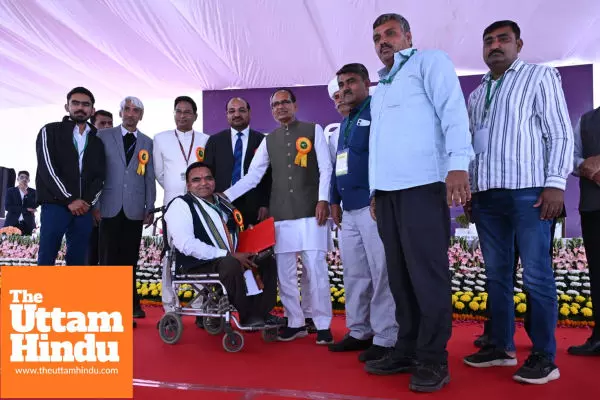
Symbolically placing farmers in the front row on the stage and personally pushing the wheelchair of a differently-abled farmer to bring him forward for discussion, the Minister emphasized that farmers are at the center of policymaking. Seven farmers were honored with the IARI Krishi Adhyeta Award, reinforcing the spirit of “Farmer First.”
Addressing agricultural reforms, Shri Chouhan first raised the issue of delayed payments to farmers. In a stern tone, he warned that any agency or state government withholding farmers’ dues would have to pay 12% interest on the delayed amount. He stated that the practice of delaying payments and “parking” farmers’ money in government accounts for financial gain would no longer be tolerated.
He clarified that the Central Government would not delay its share, and even if states delay payments under any scheme, options are being explored to transfer the Centre’s share directly into farmers’ bank accounts to ensure timely benefits.
Referring to assistance for agricultural mechanization, drip and sprinkler irrigation, polyhouses, and greenhouses, he said that while the Centre provides funds to states under more than 18 schemes, merely sending money is not enough. Citing an example where only 158 out of 700 listed farmers received machines in a district, he stressed the need for a strong monitoring system to ensure benefits reach genuine farmers.
On the role of Krishi Vigyan Kendras, the Minister said KVKs would be developed as powerful district-level units serving as bridges between research and extension. They would coordinate with states to disseminate new varieties, innovative farming practices, and successful models to villages, with structural strengthening being a key reform.
He stated that nearly 75% of small farmers currently benefit from KCC loans at an effective 4% interest rate, but delays remain unacceptable. Financial institutions and banks must ensure timely, hassle-free credit disbursal so farmers are not forced to rely on moneylenders.
Speaking on pesticide quality and licensing, Shri Chouhan acknowledged that the existing licensing process is lengthy and complex, causing delays even for genuine companies and restricting timely access to quality products for farmers. He indicated that the pesticide licensing system would be simplified, layers reduced, time limits fixed, and full transparency ensured to curb substandard and fake products.
On MSP procurement, he noted that the current three-month timeline is impractical, as farmers cannot hold produce for that long. He proposed completing MSP procurement within one month in coordination with states to ensure farmers receive prompt and fair prices, preventing middlemen from exploiting delays.
Highlighting fertilizer subsidy, the Minister said the Centre provides over ₹2 lakh crore in subsidies so that a urea bag costing ₹2,400 in reality is available to farmers for around ₹265–270. He suggested that if such a large subsidy is transferred directly to farmers’ accounts via DBT, farmers could independently decide the type and quantity of fertilizer to purchase, ensuring the real beneficiary is the cultivator.
Outlining future strategy, Shri Chouhan emphasized the “Viksit Krishi Sankalp Abhiyan,” under which teams of scientists will visit villages to directly interact with farmers on research innovations, pest and disease management, integrated farming models, and export-quality varieties. The campaign will resume in April before the Kharif season to ensure timely scientific guidance and improved seed and technology access.
Calling farmers not only “food providers” but also “life providers,” he said serving farmers is equivalent to serving God. He urged farmers to ensure not just food security but also nutrition security and high-quality agricultural products for global markets, positioning India as a true “Vishwa Bandhu” (friend of the world).
Describing the Pusa Krishi Vigyan Mela as a national “Mahakumbh” for farmers, he said the event is not merely an exhibition but a grand convergence of farmers, scientists, entrepreneurs, and policymakers, where laboratory research reaches fields directly and a roadmap for developed, modern, and self-reliant agriculture is prepared for the entire nation. He directed IARI to expand the scale of the mela from next year onward.