
The train of development arrives in the hills: Mizoram enters the railway map for the first time via the Bairabi-Sairang rail line
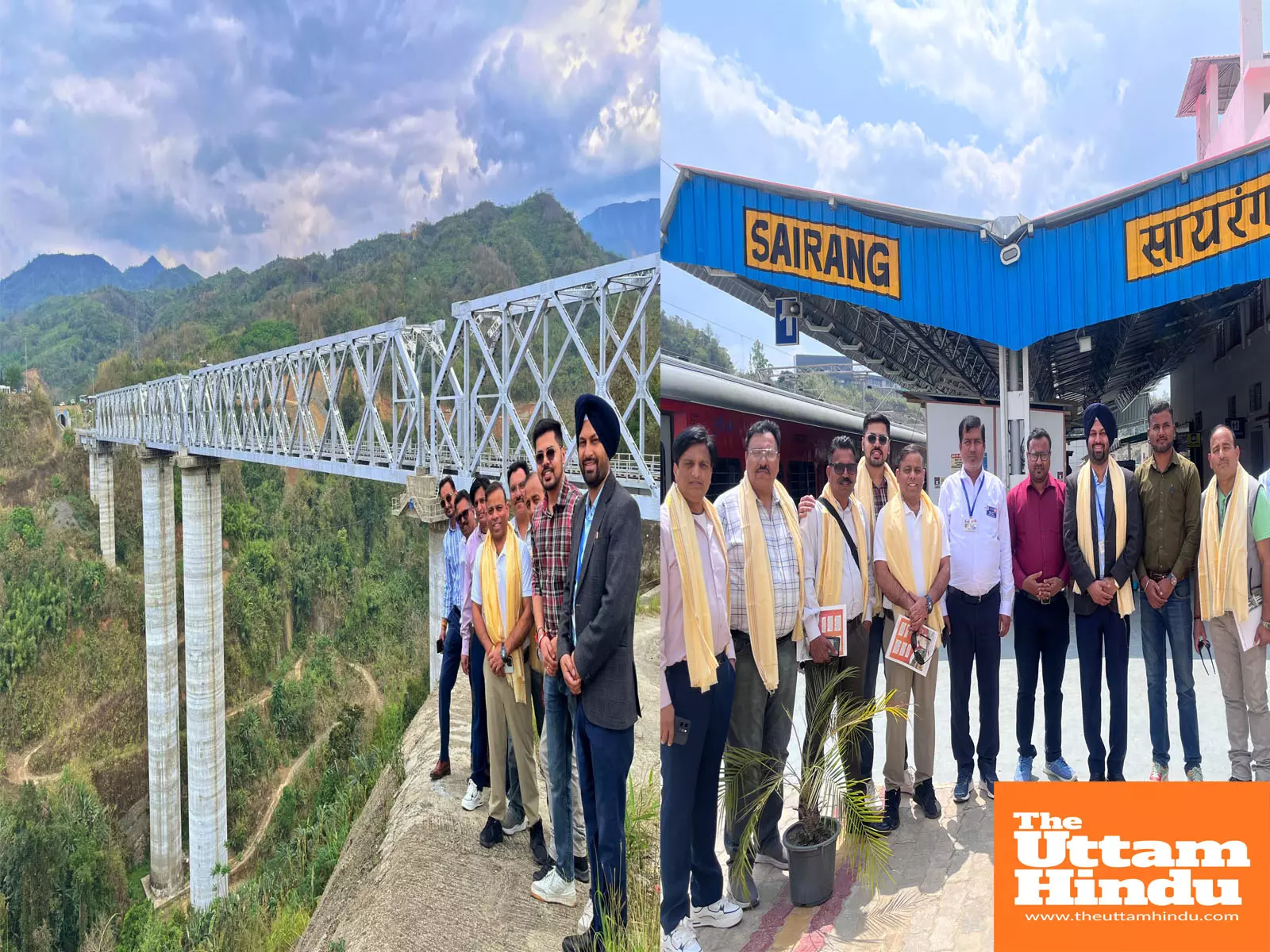
Chandigarh/Sairang(The Uttam Hindu): A delegation of media representatives from Punjab and Himachal Pradesh arrived at Sairang Railway Station on the first day of a media tour organized by the PIB. Led by Dr. Vikram Singh, Media and Communication Officer at PIB Jalandhar, this journey offered an opportunity to witness firsthand the changing landscape of development in Northeast India.
For Mizoram, the Bairabi-Sairang rail line is not merely a railway project; it represents a new pathway toward development, connectivity, and self-reliance. This historic moment for Northeast India became a reality with the completion of the 51.38 km Bairabi-Sairang rail line—a project that directly links the hilly state of Mizoram to the country's national railway map—which was dedicated to the nation by Prime Minister Narendra Modi on September 13, 2025. This is not just a railway project, but a symbol of a long-cherished hope—a dream of connecting the people of Mizoram to the national mainstream.
Until now, Mizoram was the only state in the country whose capital city remained unconnected by rail services. For a state heavily reliant on road networks and air services, rail connectivity was a pressing necessity. With the completion of the Bairabi-Sairang rail line, this gap has finally been bridged. The project traverses through the Kolasib and Aizawl districts of Mizoram and has been constructed amidst rugged hilly terrain, deep valleys, and challenging geographical conditions.
Modern engineering techniques were employed in the construction of this rail line. Constructed through a series of tunnels and towering bridges, this route has proven to be not only technically challenging but also a testament to the capability and resolve of Indian Railways. Despite adverse weather conditions, the risk of landslides, and the sheer inaccessibility of the terrain, the project was successfully advanced—a feat that makes it all the more remarkable.
For the local population, this railway line has brought about a transformative change in their lives. Commuting has now become significantly easier for the state's farmers, traders, students, and patients. Transporting agricultural and horticultural produce to other parts of the country has been simplified, providing a major boost to the local economy. The project has also unlocked new opportunities for the tourism sector, as tourists from across the nation can now easily access Mizoram.
On a social level, the impact of this railway line has been profound. Improved access to education, healthcare, and employment opportunities has helped in mitigating regional disparities. This project is being hailed as a decisive step toward addressing the long-standing connectivity deficit faced by the Northeastern states.
The Bairabi-Sairang railway line opens up a new gateway for development—not only for Mizoram but for the entire Northeastern region. This project demonstrates that geographical challenges need not be obstacles on the path to development, provided the resolve is strong. Traversing through the mountains, this railway line has now become the new track for Mizoram's dreams, potential, and progress.
A Major Engineering Challenge Made Possible
This project showcases the modern technical capabilities of Indian Railways, highlighted by the following features:
1. The line traverses through inaccessible hilly terrains, deep valleys, and dense forests. The project adhered to the principle of minimal environmental intervention. Eschewing the conventional "cut-and-fill" method, tunnel-based construction techniques were employed instead. This approach ensured slope stability, structural safety, and ecological balance.
2. During the construction phase, a total of 45 tunnels were excavated, with the longest tunnel measuring 1,868 meters. 3. A total of 142 small and high bridges were constructed, the tallest of which stands at 114 meters—42 meters taller than the Qutub Minar.
4. The project was successfully executed despite challenges such as landslides, heavy rainfall, and limited resources.
Boost to Economy and Tourism
1. Rail connectivity is expected to accelerate economic activities within the state.
2. Horticulture, agriculture, and handicrafts sectors will gain access to new markets.
3. Tourism will receive a significant boost—tourists from across the country now have easy access to Mizoram.
4. Local homestays, hotels, and the service sector will benefit directly.
5. To date, nearly 70 freight trains have arrived in Mizoram, transporting commodities such as cement, sand, gravel, automobiles, and urea, thereby reducing logistics costs.
Social and Strategic Impact
1. Instrumental in reducing regional isolation.
2. Strengthens connectivity and cooperation between the Northeastern states and the Central Government.
3. Improves the speed and efficiency of emergency and supply services.
4. Bolsters infrastructure in border areas.
5. Travel time from Bairabi to Sairang via the rail route is just 50 minutes, whereas the journey takes over 4 hours by road.
Trains Currently Operating from Sairang
Sairang–Guwahati Express (15610): Daily
Sairang–Kolkata Express (13126): 3 days a week
Sairang–Anand Vihar (Delhi) Rajdhani Express (20507): Weekly (Every Friday)
Sairang–Silchar Passenger (55670): 5 days a week
Approximately 450 passengers book tickets daily from the Sairang Railway Station counter. This figure does not include tickets booked through automatic vending machines or mobile apps.
Bairabi-Sairang Rail Line (Electrification)
Work on the electrification of this 51.38 km long rail line is currently in progress. Initially, the target for its completion was March 31; however, due to the presence of numerous tunnels, installing the overhead equipment correctly is taking longer than anticipated. The work is expected to be completed within the next two months, following which train operations in this section will transition from diesel locomotives to electric trains.
The Ultra-Modern Sairang Railway Station
Although the railway network reached Mizoram 78 years after independence, Sairang Railway Station is remarkably advanced in terms of modernization. The station is equipped with a comprehensive range of facilities, ranging from automatic vending machines to digital payment options. Food stalls are also available on the premises, where, according to reports, daily sales range between ₹15,000 and ₹20,000. In addition to three passenger platforms, dedicated lines are also available for freight trains. The station also features excellent parking facilities.