
James Webb telescope discovers primitive stars 10,000 times heavier than the sun, solving cosmic mystery
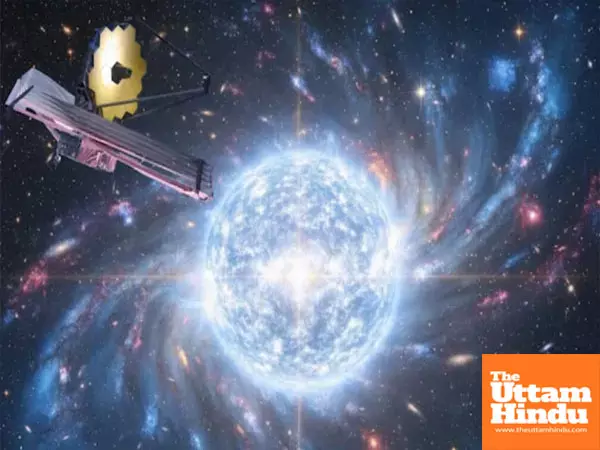
Washington (The Uttam Hindu): Scientists working to understand the origins and early form of the universe have achieved a historic breakthrough with the James Webb Space Telescope (JWST). Scientists have found definitive evidence of giant primordial stars in space, known as "monster stars" in the world of astronomy. This discovery has solved an astronomical puzzle that has been a subject of speculation for the past two decades. It is believed that each of these primordial stars may have weighed 1,000 to 10,000 times more than our Sun and came into existence only a few hundred million years after the Big Bang. Now, the existence of these stars is no longer mere speculation, but a scientific reality.
This revolutionary discovery was made by researchers from the Harvard & Smithsonian Center for Astrophysics and the University of Portsmouth, a joint study published in The Astrophysical Journal Letters. The team used the James Webb Telescope to study the distant galaxy GS 3073. Scientists found that a very specific ratio of nitrogen to oxygen (0.46) exists within this galaxy. According to scientists, this elevated nitrogen level is a "chemical signature" that strongly suggests that the galaxy was once filled with massive stars. Daniel Whelan, a researcher at the University of Portsmouth, says that with the galaxy GS 3073, they now have the first direct and convincing evidence of the existence of these massive stars.
Scientists believe this discovery will also help understand how supermassive black holes formed so quickly in the early stages of the universe. To understand the life cycle of these giant stars, researchers used computer simulations. The models revealed that these monster stars burn helium gas in their cores to form carbon. This carbon then combines with hydrogen to form nitrogen through a process called the CNO cycle. This nitrogen is carried to the star's surface by convection currents and then spreads into space, leaving a chemical imprint that persists for billions of years.
Devesh Nandal, a scientist at the Swiss National Science Foundation, has called this discovery a "cosmic fingerprint." He says the chemical pattern observed in the GS 3073 galaxy doesn't match any normal star. The high concentration of nitrogen there points to only one source: primordial stars thousands of times more massive than the Sun. This study proves that the first generation of stars included truly unimaginable giants, laying the foundation for today's universe.