
Unveiling UV light: The science behind the sun's invisible rays
Ultraviolet (UV) light is a type of electromagnetic wave with a shorter wavelength than visible light, invisible to humans but visible to some creatures like bees and are of three types: UV-A, UV-B, and UV-C, with varying effects on living organisms and the environment
New Delhi (The Uttam Hindu): Ultraviolet light, also known as ultraviolet (UV) rays, is a specific type of electromagnetic wave. Its wavelength is shorter than visible light, making it invisible to the human eye. However, some creatures in nature, such as bees and bumblebees, have the remarkable ability to see it.
The science of UV light not only protects our skin, but also helps us understand the depths of the universe. These invisible rays present in sunlight are essential for life, but excessive exposure can also cause harm. Scientists are constantly studying them to better understand both the universe and Earth.
The sun is the largest natural source of UV light. Scientists divide UV rays from the sun into three main types: UV-A, UV-B, and UV-C. UV-C is the most dangerous, but the Earth's atmosphere absorbs almost all of it. UV-B rays cause sunburn and can damage the DNA of living organisms. Fortunately, the ozone layer blocks about 95 percent of UV-B rays. UV-A rays are the longest-wavelength rays and can penetrate deep into the skin and cause aging.
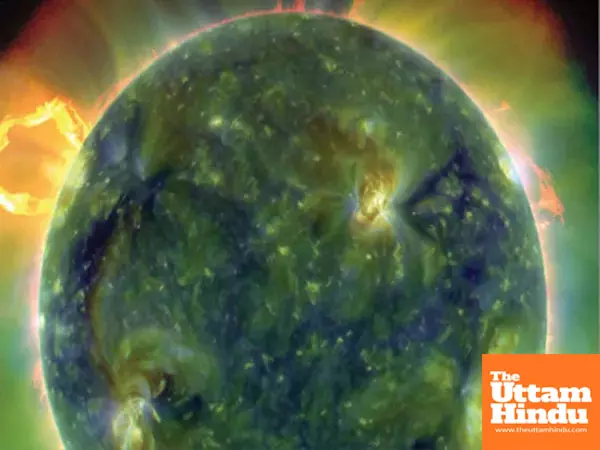
Astronomers further divide UV light into finer ranges, such as near UV (NUV), middle UV (MUV), far UV (FUV), and extreme UV (EUV). The US space agency NASA's Solar Dynamics Observatory (SDO) spacecraft has taken extreme UV images of the Sun. In these false-color images, different colors represent the temperature of the Sun's hot plasma gases. Red represents about 60,000 degrees Celsius, while blue and green represent very hot regions, exceeding about one million degrees Celsius.
UV light was discovered by German scientist Johann Ritter in 1801. Ritter observed that photographic paper darkened quickly in blue light. He exposed the paper to invisible light beyond violet, and it darkened rapidly. This proved that energy exists beyond the violet spectrum, which was later called ultraviolet. Earth's atmosphere blocks most of the high-energy UV rays. Therefore, scientists use satellites to study UV light coming from the sun and other stars and galaxies.
Newly formed stars shine mostly in UV light. NASA's GALEX mission captured UV images of the M81 galaxy, clearly showing regions of new star formation. NASA's Ultraviolet Imaging Telescope captured images of three galaxies during the Astro-2 mission. Young, massive, and hot stars shine brightly in UV light, while older, cooler stars are more visible in visible light. This gives scientists important insights into galaxy evolution and the birth and death of stars.