
World’s most acidic turquoise lake emits blue fire, science reveals the mystery
Kawah Ijen lake emits blue fire due to sulfuric gases igniting at high temperatures.
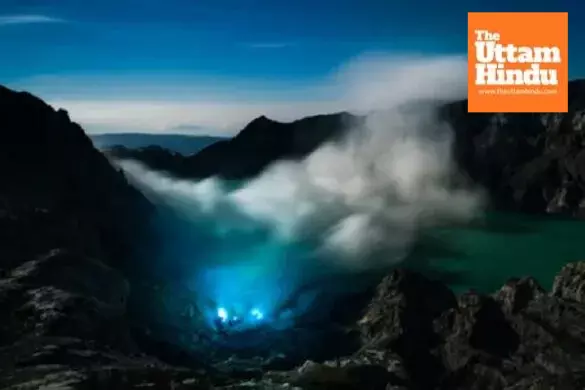
New Delhi (The Uttam Hindu): Nature often surprises with its beauty and mystery and one such place is Kawah Ijen in Indonesia. Located within the volcanic complex of Mount Ijen, this turquoise crater lake is part of a region recognized by UNESCO for its unique geological and cultural significance. The area features a dramatic volcanic landscape shaped over millions of years with numerous cones craters and lava formations.
The Ijen Geopark includes around 22 volcanic cones within its caldera system and is linked to a biosphere reserve designated in 2016. The lake itself is visually stunning but also extremely dangerous with a pH level below 0.3 making it the most acidic crater lake in the world. For comparison even lemon juice has a much higher pH level. The acidity is caused by volcanic gases chemical reactions with surrounding rocks evaporation and underground hot water activity. The nearby Banyupahit River also carries acidic water which affects the surrounding environment.
One of the most fascinating features of this region is the rare blue fire phenomenon. Sulfuric gases emerging from cracks in the crater ignite at temperatures above 360 degrees Celsius producing striking blue flames instead of the usual red or orange seen in most volcanic eruptions. This phenomenon is visible only at night as daylight hides the glow. Despite its beauty the area remains hazardous as it is an active volcanic site where sulfur mining takes place. Workers extract sulfur by cooling the gases but the process is risky due to exposure to toxic fumes.