
Expert warns of ‘political stagnation’ risk in US-India relations
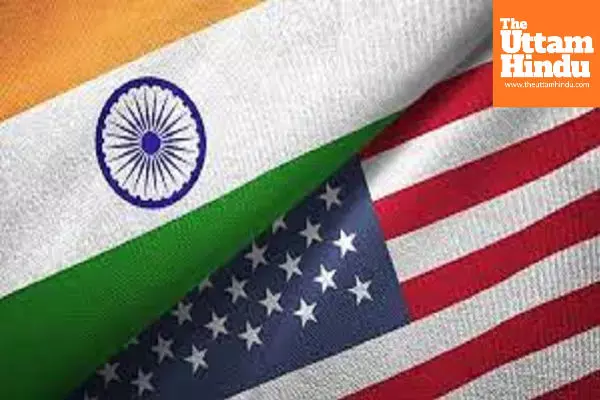
Washington (The Uttam Hindu): An expert has warned that the strategic partnership built between the United States and India over the past two decades is now facing the risk of “political stagnation.” Dhruva Jaishankar, Executive Director of ORF America, said in a written statement that if rising political tensions are not handled in time, the progress achieved over many years may come under threat. His statement came ahead of a key hearing of the US House Foreign Affairs Committee scheduled for Wednesday.
Jaishankar said that US-India ties, which have steadily strengthened under various governments in both countries, have reached a point of “political pause.” He identified two main reasons: growing disputes over trade and tariffs, and Washington’s increasing engagement with Pakistan’s military leadership.
He explained that this same partnership has grown since 1998 through economic cooperation, the Indo-Pacific strategy, and concerns over China’s aggressive actions. Now, when both nations face China’s rising influence and global instability, slowing the partnership could prove dangerous.
He also described how the lifting of sanctions in 1999, the 2008 Civil Nuclear Agreement, defence cooperation, improved military interoperability, the revival of the Quad, and collaborations in space, critical minerals, and artificial intelligence have brought the two countries closer.
But he warned that this progress now seems obstructed. According to him, the current situation could weaken the ambitious bilateral agenda set by President Trump and Prime Minister Modi in February 2025, and could affect strategic cooperation in the Quad, the Middle East, and global issues.
Jaishankar noted that China’s military strength is now at par with the United States. He referred to Chinese border incursions, the 2020 Galwan clash, the rapid expansion of China’s navy, and the construction of dual-use ports across the Indo-Pacific.
India, too, has increased maritime patrols since 2017 and strengthened cooperation with several partners, including through the Quad’s Maritime Domain Awareness programme. Jaishankar added that after India’s retaliatory action against Pakistan following the April terror attack, the US response and its growing engagement with Pakistan’s military leadership have strained India-US ties.
He highlighted Pakistan’s long record of supporting terrorism and said it remains a constant security threat to India and the region. He also pointed out that after the bilateral trade agreement collapsed, the US imposed tariffs that are now among the highest applied to any country. These tariffs have negatively impacted exporters, investors, and workers in both nations. If they continue, he warned, India may view them as “political hostility.”
Despite tensions, cooperation in defence, energy, and technology continues to move forward. Major developments this year include a 10-year defence framework agreement, major defence deals, expanded military exercises, NASA-supported human spaceflight collaboration, the launch of the jointly developed NISAR satellite, and India’s $1.3-billion LNG import agreement.
Jaishankar emphasized that the four main pillars of the partnership trade, energy, technology, and defence remain strong. He also pointed to vast potential in artificial intelligence, critical minerals, semiconductor supply chains, and defence co-production under India-US trust initiatives.