
India tops global list with 56% share in IRCC certificates under Nagoya protocol
India becomes global leader in IRCC certificates under Nagoya Protocol with 56% share, showcasing strong biodiversity governance and compliance framework.
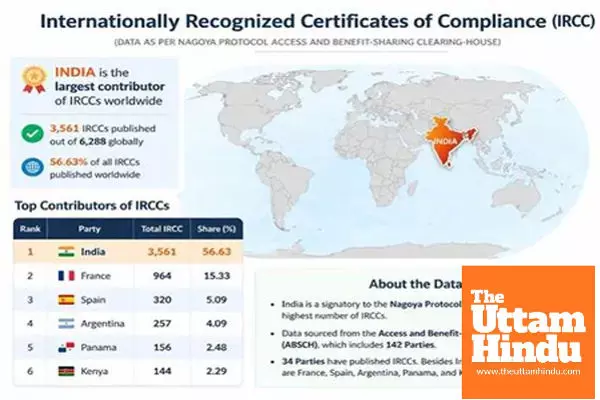
New Delhi (The Uttam Hindu): India has emerged as the global leader in issuing Internationally Recognized Certificates of Compliance (IRCC) under the Nagoya Protocol. According to the latest data released by the ABS Clearing-House, India accounts for more than 56 percent of all such certificates issued worldwide.
Out of a total of 6,311 global certificates, India alone has issued 3,561 IRCCs, significantly outperforming other countries and establishing itself as the top contributor in implementing the protocol.
Developed nations like France and Spain lag behind
The ABS Clearing-House platform, which promotes transparency and accountability, has participation from 142 countries. However, only 34 countries have issued IRCCs so far.
India ranks first on this list, followed by France with 964 certificates. Spain (320), Argentina (257), Panama (156), and Kenya (144) follow behind. These figures highlight India’s strong commitment to the transparent use of biological resources and associated traditional knowledge.
What is the Nagoya protocol and IRCC?
Under the Nagoya Protocol, countries that grant access to their genetic resources and traditional knowledge must issue IRCCs. These certificates serve as official proof that prior informed consent has been obtained and mutually agreed terms have been established between the user and the provider.
Once approved, all relevant details are uploaded to the ABS Clearing-House portal, enabling monitoring of resource usage and its commercial applications.
How India achieved this milestone
India’s top position globally reflects the strength of its regulatory framework under the Biological Diversity Act, 2002. The system is implemented through the National Biodiversity Authority at the central level, supported by state boards and local biodiversity management committees.
This structured approach has helped in faster processing of applications and ensured strict compliance with international obligations. India’s achievement further strengthens its position as a key player in global environmental agreements and biodiversity conservation.
- Tags
- #Biodiversity