
Iran on the edge as 115 killed and coup whispers grow louder
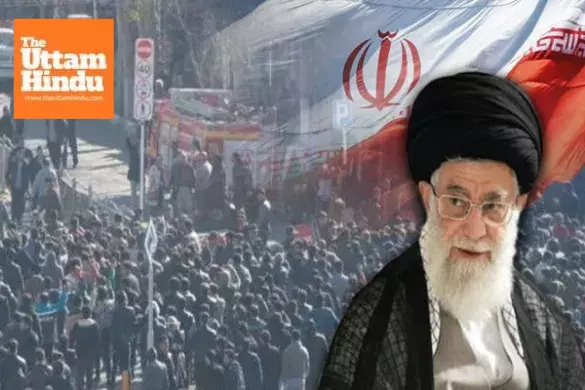
New Delhi (The Uttam Hindu) – Since December 28th of last year, street protests have been ongoing in Iran against the government of Supreme Leader Ayatollah Ali Khamenei. The protests are gradually becoming more violent. So far, more than 115 people have been killed, and more than 2,000 have been detained. Speculation is rife that a coup could be imminent in Iran. Recent government changes in Venezuela, Nepal, and Bangladesh are fueling these speculations. Meanwhile, discussions continue to rage about America's role in all of this.
Amid ongoing protests in Iran, increasing repression, and open dissent against the top leadership, the question has intensified whether the country is heading for a major political change. In recent months, the Iranian public has been angered by inflation, unemployment, restrictions on social freedoms, and the centralization of power. In Bangladesh, political protests began before the overthrow of Sheikh Hasina's government. This protest gradually spread among the youth, who expressed considerable dissatisfaction and anger against Hasina's government. The result was that these protests quickly turned violent, resulting in the loss of many lives. Ultimately, Sheikh Hasina's government fell.
Furthermore, if we talk about the Zenji movement in Nepal, similar circumstances prevailed there. The Zenji movement in Nepal was the largest movement of 2025. Political protests first began in Nepal, which quickly evolved into the Zenji movement. Organized through social media, this movement spread the anti-government narrative widely and paved the way for regime change. Recently, the US intervened in Venezuela. The US kidnapped then-President Nicolas Maduro overnight and brought him to New York. The US also attacked several locations in Venezuela. While this US action was strongly criticized worldwide, the people of Venezuela celebrated it with great enthusiasm. Venezuelan youth, in particular, were rejoicing at the fact that they had been freed from Maduro's regime.
This is why many analysts are beginning to view the current situation in Iran along similar lines. The participation of youth, women, and university leaders in the recent protests in Iran has posed a challenge to the Khamenei government. Internet and phone services have been disrupted in the country for over 60 hours. However, the US has been supporting these protests from the beginning. The US has even threatened the Khamenei government with attacks if the government uses force against the protesters. Discussions have also been rife about the US's indirect role in these protests. US rhetoric in Iran, Venezuela, Nepal, and Bangladesh is drawing attention. However, the lack of concrete evidence of direct US involvement in these movements makes it difficult to put an end to these speculations. In the context of Iran, too, criticism of human rights violations, sanctions, and diplomatic pressure from the US and Western countries are already evident. Meanwhile, Tehran has also accused external forces of promoting internal instability.
The Iranian Embassy in India posted a video of Khamenei, in which he didn't name any names, but clearly stated that every possible means of pressure was used against Iran, but thank God the Islamic Republic remains powerful. Khamenei says in the video, "The Islamic Republic of Iran is strong, powerful, and prosperous in the world today, contrary to their wishes. They have been able to do everything in the last 40 years. In other words, no decisive action has ever been taken against any country." Iran's Supreme Leader continued, "They have carried out military, security, economic, cultural, and labor attacks. Some weak people here and there have used their own money over the past few years, and they have lost. They have found no place. Today, Iran is ruled by the Islamic Republic. This is the Islamic Republic of Iran."
- Tags
- #Iran