
Nepal to Amend Constitution After 10-Point Agreement Between Government and Gen-Z on Electoral Reforms
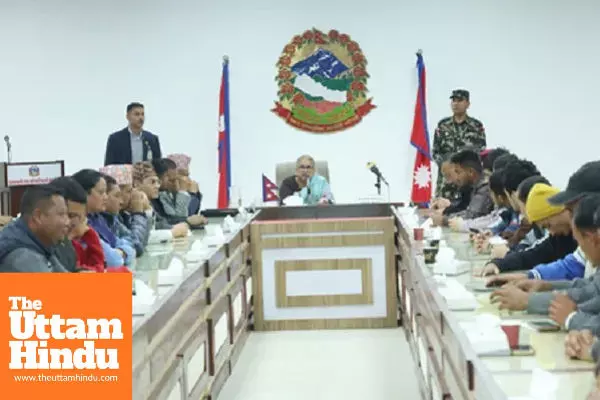
Kathmandu (The Uttam Hindu): Nepal’s interim government has decided to move forward with amendments to the existing Constitution to ensure population-based inclusive representation and introduce term limits for major elected government positions. A 10-point agreement was reached on Wednesday night between the government and Gen-Z representatives, under which a high-level Constitutional Amendment Recommendation Commission will be formed. This commission will include stakeholders, independent experts, and Gen-Z representatives.
The commission will be tasked with preparing recommendations for progressive constitutional reforms aligned with the aspirations of Gen-Z protesters, whose movement led to the collapse of the previous KP Sharma Oli government and the formation of the interim government headed by Sushila Karki.
One of the major responsibilities of the commission will be to suggest electoral reforms that ensure fair and inclusive representation based on the population of different communities. At present, Nepal follows a mixed electoral system, combining First-Past-The-Post and Proportional Representation. Under this, 60% of representatives are elected through FPTP, while the remaining 40% come through proportional representation.
The agreement also requires the commission to recommend a maximum of two terms (not exceeding ten years) for the heads of the state and executive bodies across all three levels of government, federal, provincial, and local. Currently, term limits apply only to the President, Vice President, and heads of local governments, with no such limits for federal or provincial heads.
During discussions, it was highlighted that the repeated rotation of the same political leaders without meaningful results created widespread frustration, especially among Nepal’s youth. This dissatisfaction fueled the Gen-Z protests seen in September 2024.
Before the Gen-Z movement, Nepal’s leadership frequently shifted among top leaders such as Sher Bahadur Deuba (Nepali Congress), KP Sharma Oli (CPN-UML), and Pushpa Kamal Dahal ‘Prachanda’ (Nepal Communist Party), all of whom faced strong criticism during the protests.
The commission will also study the proposal to lower the minimum age for contesting elections to 21 years for positions in the House of Representatives, provincial assemblies, and local-level bodies. Currently, the minimum age is 25 for federal and provincial elections, while 21 applies only to local-level positions. To address increasing appointments based on political loyalty and financial interests, the commission will review the existing structures responsible for such appointments.
When the KP Sharma Oli government was formed in July 2024, its coalition partners—the Nepali Congress and CPN (UML)—had promised constitutional amendments to achieve political stability. They had even suggested scrapping the proportional representation system so a single party could secure a clear majority. However, no steps were taken before the government collapsed following the Gen-Z protests in September.