
Iranian missile hits US Air Force's 'backbone', destroys Rs 6600 crore E-3 Sentry aircraft
The US remains tight-lipped, while experts call it a "devastating blow" to their aerial operations
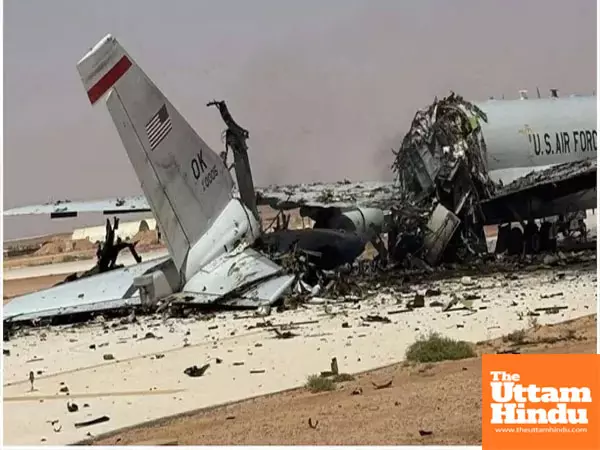
Riyadh (The Uttam Hindu): Amidst the simmering war in West Asia, Iran has delivered a devastating and precise blow directly to the United States. Iran's horrific missile and drone attack on Saudi Arabia's Prince Sultan Air Base has dealt a severe blow to American military power, reverberating as far as Washington. The massive attack, which took place on March 27th, destroyed the vital E-3 Sentry AWACS aircraft, considered the "eyes and ears" of the US Air Force. Several aerial refueling tanker aircraft were also destroyed in the horrific attack. Iran's claims that more than 10 American soldiers were injured in the attack, two of whom are battling for life, have shocked the United States.
6600 crore rupees worth 'Aasmani Sikandar' burnt to ashes
The images of devastation that have emerged on social media following this horrific attack are nothing short of a nightmare for the US military. The Islamic Republic of Iran Broadcasting (IRIB) has openly challenged the US by sharing photos of the destroyed aircraft on its "X" handle. Flight tracking data has shockingly revealed that approximately six E-3 Sentry aircraft were stationed at the base just before the attack. The destruction of this surveillance aircraft, which can detect enemy movements from the sky, has crippled US aerial operations. According to a report, the cost of this single aircraft, reduced to ashes, was approximately $700 million, or approximately Rs 6600 crore. However, the US Central Command has maintained a mysterious silence on this massive devastation.
E-3 Sentry is a flying 'control room'
Why did Iran target this aircraft? The answer lies in its unlimited capabilities. The E-3 Sentry aircraft is considered the backbone of US aerial operations. It is no ordinary aircraft, but a complete flying control and command center. In service since the 1970s, this aircraft has proven to be a game changer for the US in major military operations like Operation Desert Storm, the Kosovo War, Iraq, and Afghanistan. It is unmatched in gathering accurate intelligence across the battlefield and coordinating fighter jets. Its destruction means that the US Air Force has been temporarily blinded in the skies over the Middle East.
The war will have a huge impact
Iran's precise and devastating strike has surprised defense experts worldwide. Heather Penny, a former US Air Force F-16 pilot and defense policy expert, described it as a deeply worrying situation. She compared the aircraft to a chess player with a "mastermind" who oversees the entire board, and whose pawns (fighter pilots) move at his behest. Experts believe this attack is not a fluke, but part of Iran's well-thought-out and precise military strategy. Iran's direct aim is to completely destroy US air power's most important and expensive radar systems, communication networks, and high-value aircraft.
What will America do now?
This audacity by Iran has sparked a new and serious debate about the future of the US Airborne Battle Management System. The immediate replacement of this massive loss of the E-3 Sentry has become a monumental challenge for the Pentagon. Although the US is considering the Boeing E-7 Wedgetail aircraft as a possible replacement, the delay in procuring the new system is putting severe pressure on the existing aging AWACS fleet. This single attack has not only cost the US billions of dollars but has also exposed its long-term strategy and war preparedness in the Middle East.