
US and Iran head to Islamabad for crucial talks amid fragile ceasefire, nuclear issue takes center stage
US Vice President JD Vance is leading a high-level delegation to Islamabad for talks with Iran, focusing on the country's nuclear program, sanctions relief, and control of the Strait of Hormuz
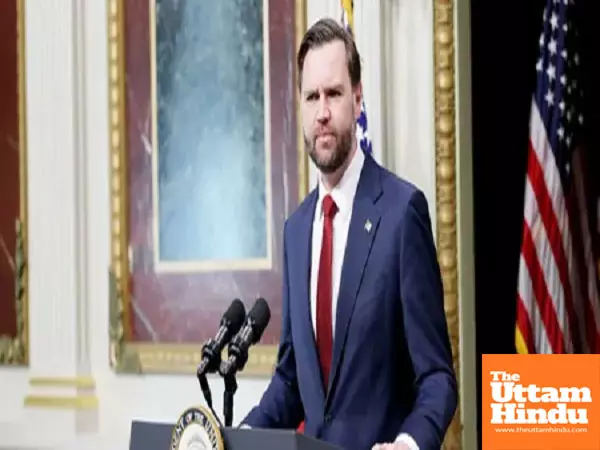
WASHINGTON (The Uttam Hindu): After concluding his visit to Hungary, US Vice President J.D. Vance will head to Islamabad later this week, where he will lead a high-level US delegation for talks with Iran. The visit comes as Washington is trying to cement a fragile ceasefire following recent weeks of military tensions. The Trump administration is stepping up diplomatic efforts to turn this ceasefire into a lasting peace.
The White House said on Wednesday that the negotiating team would include Special Envoy Steve Witkoff and Jared Kushner, indicating that the administration now wants to move forward with an organized diplomatic process after that phase. "I can announce that the President is sending his team to Islamabad this weekend for talks, led by Vice President J.D. Vance, Special Envoy Witkoff, and Mr. Kushner," White House Press Secretary Carolyn Levitt told reporters. "The first round of these talks will take place on Saturday," she added.
Speaking to the media on his way back from Hungary, Vance emphasized that parallel diplomatic talks between Pakistan and Iran had already been scheduled. "We have a dialogue that's scheduled to begin this weekend. That's true. I think it's a good step." These talks are taking place after President Donald Trump announced a two-week ceasefire following "Operation Epic Fury," a ceasefire the government says has significantly degraded Iran's military capabilities.
Press Secretary Levitt said, "This is a victory for America, made possible by the President and our tremendous military." According to the White House, the pressure from the military operation forced Tehran to agree to a ceasefire and reopen the Strait of Hormuz. "As a result of the President's continued pressure and the leverage created by the success of Operation Epic Fury, the Iranian government sought and ultimately agreed to a ceasefire," he said.
Vance said the ceasefire framework is based on conditions. It's a ceasefire as well as a negotiation process. "We give something from our side and in return we expect them to reopen the straits," he warned, warning that if these conditions are not followed, there could be consequences. Despite diplomatic efforts, the government has warned that the ceasefire remains unstable. "This is a fragile ceasefire. Ceasefires are fragile by nature," Levitt said.
Vance made clear that Iran's nuclear program will be central to Islamabad's core agenda. He said, "We want Iran to be unable to develop nuclear weapons. We want Iran to give up nuclear fuel." Levitt reiterated that the president's conditions, namely, a complete end to uranium enrichment in Iran, remain in place and unchanged.
Meanwhile, Vance dismissed media reports of Iran's proposals, saying, "Three separate 10-point proposals were presented, but the first one was immediately rejected." He stressed that Washington believes Tehran is now negotiating more seriously. He said, "What's happening on the ground in Iran is that the government's position is clear, which is to negotiate with the United States."